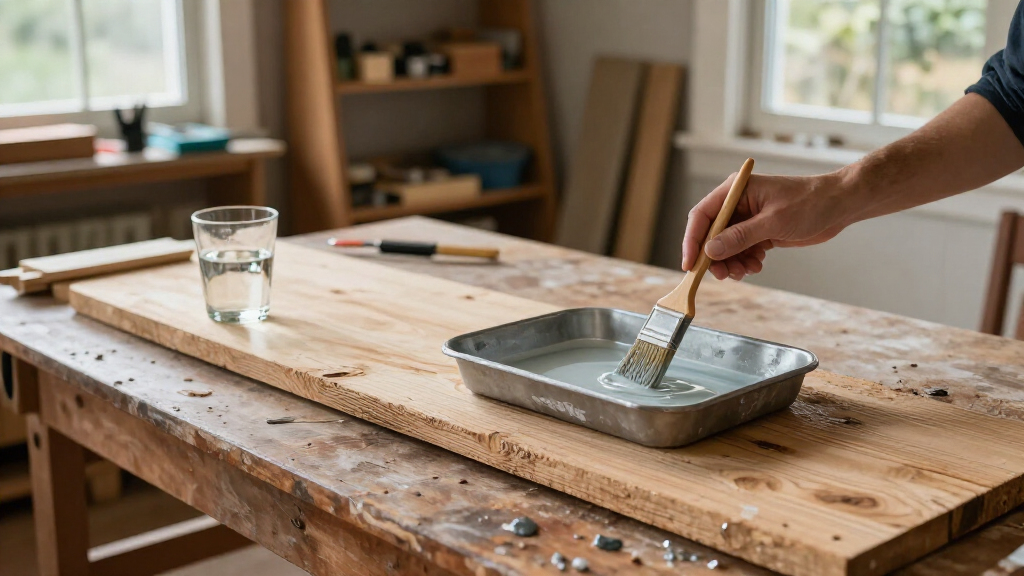
TL;DR
Professional painter Scott Paskewitz says adding water is not a routine way to make paint easier to apply or make it last longer. Water may be used in limited cases with some water-based primers, but the product label should control; oil-based paint should never be thinned with water, and exterior paint should not be diluted.
Professional painters do not typically add water to paint to improve application or make a can go farther, Scott Paskewitz, owner of Scott’s Painting & Staining Inc. in Omaha, told Hunker. He said water may be used in limited circumstances with some water-based products, but painters should follow the manufacturer’s label rather than rely on a general thinning rule.

Get business pricing on tools and workshop supplies
- Business-only prices and quantity discounts
- Tax-exempt purchasing
- Multiple users, one account, clear invoices
Paskewitz said his company uses paint as supplied by the manufacturer and does not add water simply to make it easier to apply or to stretch the product. Diluting paint to cover more area is not recommended, he said, because the amount of paint used should not be reduced by thinning it. The report suggests rollers or sprayers as alternatives when working with a small quantity of paint.
There are important product limits. Water should never be added to oil-based paint, Paskewitz said. He also advised against adding it to exterior paint, which needs to maintain the right film thickness to perform as designed and flex with the surface without cracking or failing prematurely.
For some interior trim work, adding water to latex paint may improve flow, but Paskewitz said a paint additive such as Floetrol is a better option. He also described limited use of water to thin certain primers that have become too thick, potentially because water has evaporated during storage. In either case, he said, check the label and follow the product’s directions.
Adding Water to Paint When It’s Appropriate
Professional painter Scott Paskewitz says thinning is not a routine way to improve application or stretch paint. The product label should guide any exception.
The usual practice
Paskewitz says his painters use paint as supplied by the manufacturer.
- Adding water to stretch a can or cover more area
- Adding water to oil-based paint
- Diluting exterior paint
- Using a roller or sprayer with a small quantity
- Checking whether the label permits thinning
- Considering Floetrol for flow on some latex paint
Limited exceptions
Water may be suitable for some water-based products, depending on the task and label.
Check before thinning
Paskewitz described limited water use for certain thickened primers. Follow that product’s directions.
Consider an additive
Water may improve flow with some latex paint, but Paskewitz suggested Floetrol as a better option.
Why exterior paint is different
Exterior coatings need the intended film thickness to perform and flex as designed.
Diluting paint to make it cover more area may compromise its intended performance.
Paskewitz advises against water in exterior paint to help prevent cracking or early failure.
Before mixing
Paint and primer formulas are not interchangeable, and there is no universal thinning rule.
How Thinning Can Affect Paint Performance
The advice matters because thinning paint changes the product being applied. In particular, Paskewitz warned that exterior coatings need to retain their intended film thickness to perform and flex as designed. Adding water to make a can cover more area may compromise that goal rather than provide a dependable way to save paint.
For people working indoors, the takeaway is not that water is always prohibited, but that its use depends on the product and task. A smoother flow may be possible with some water-based paint, yet an additive may be more suitable. For oil-based paint and exterior coatings, the contractor’s advice is clear: do not add water. Reading the label can help prevent a well-intended adjustment from working against the paint’s intended use.
Products Worth Considering

TCL 75-Inch Class 4-Series 4K UHD HDR Smart Google TV (75S446, 2022)

iRobot Roomba 415X Robot Vacuum & Mop Combo

Shark Pet Cordless Stick Vacuum, Up to 40-Minute Runtime, Lightweight, IX141
As an affiliate, we earn on qualifying purchases.
Why Paint Labels Set the Limits
The advice was given in response to common claims that water can help paint flow, extend its drying time or make it last longer. Paskewitz’s account distinguishes those claims from his company’s routine practice: his painters generally apply paint as supplied, rather than dilute it for convenience or to extend the amount.
His comments also distinguish among water-based paint, oil-based paint, exterior coatings and primers. They are not interchangeable categories for thinning advice. Paskewitz said limited water use may be appropriate for some primers that have thickened, but directed readers to the individual manufacturer’s instructions. He did not provide a universal mixing ratio or say that every primer can be thinned.
“Professional painters do not typically add water to paint as a routine practice.”
— Scott Paskewitz, owner of Scott’s Painting & Staining Inc., speaking to Hunker
Which Products Allow Thinning
The advice does not identify specific paint or primer products whose labels permit thinning, give a recommended amount of water, or establish that water is suitable for every water-based paint. Paskewitz described limited use with some primers but did not specify brands or formulas. Whether thinning is permitted—and what to use—depends on the product’s own directions.
The report also does not provide comparative tests of water versus paint additives, or quantify how dilution affects coverage, drying time or finish. Those outcomes should not be assumed from the general advice. Readers should check the can or the manufacturer’s guidance before changing the paint.
Check the Can Before Mixing
Before adding anything, painters should read the product label for instructions on thinning and application. If the label permits thinning, Paskewitz’s advice is to follow its directions rather than apply a one-size-fits-all rule. For a flow problem, he recommended considering a product such as Floetrol instead of automatically adding water; for thickened primer, he described water use only in a limited capacity.
If the label does not permit thinning, or the product is oil-based or intended for exterior use, do not add water based on this advice. The next step is to follow the manufacturer’s application guidance or seek product-specific direction. The report does not identify any broader change in professional practice or provide a timetable for further guidance.
Source: rss
Key Questions
Should you add water to paint to make it go farther?
No. Paskewitz said paint should not be diluted simply to reduce how much is used. He suggested using rollers or sprayers when working with a small amount instead.
Can you add water to oil-based paint?
No. Paskewitz said water should never be added to oil-based paint.
Is it recommended to add water to exterior paint?
Paskewitz advised against it. He said exterior coatings need the proper film thickness to perform as designed and flex without premature cracking or failure.
Can water be added to latex paint or primer?
In limited cases, water may be used with some water-based paints or primers, but it is not a routine recommendation. Check the label first and follow the manufacturer’s instructions; Paskewitz suggested Floetrol as an alternative for improving flow.
Source: hunker.com