If you’re choosing between fine-finish and production airless sprayers, consider your project needs. Fine-finish sprayers offer narrow, precise spray patterns perfect for detailed, high-quality work, but they’re more delicate and require careful adjustments. Production sprayers provide wider coverage for faster jobs and are built to handle thick coatings and large areas. Picking the right machine depends on whether you prioritize detail or speed. Keep exploring to learn which sprayer suits your project best.

Get business pricing on tools and workshop supplies
- Business-only prices and quantity discounts
- Tax-exempt purchasing
- Multiple users, one account, clear invoices
Key Takeaways
- Fine-finish airless sprayers provide narrow, precise spray patterns ideal for detailed, high-quality coatings; production sprayers offer wider patterns for faster coverage.
- Fine-finish models are more delicate, made with high-quality materials for precision; production units are robust, designed for durability and heavy use.
- Use fine-finish sprayers for meticulous, smooth surfaces; production sprayers are better for large-area projects like priming or base coats.
- Fine-finish equipment requires careful setup and maintenance; production sprayers are easier to operate with minimal fine-tuning.
- Choose fine-finish for detailed, flawless results; opt for production sprayers when speed, coverage, and durability are priorities.
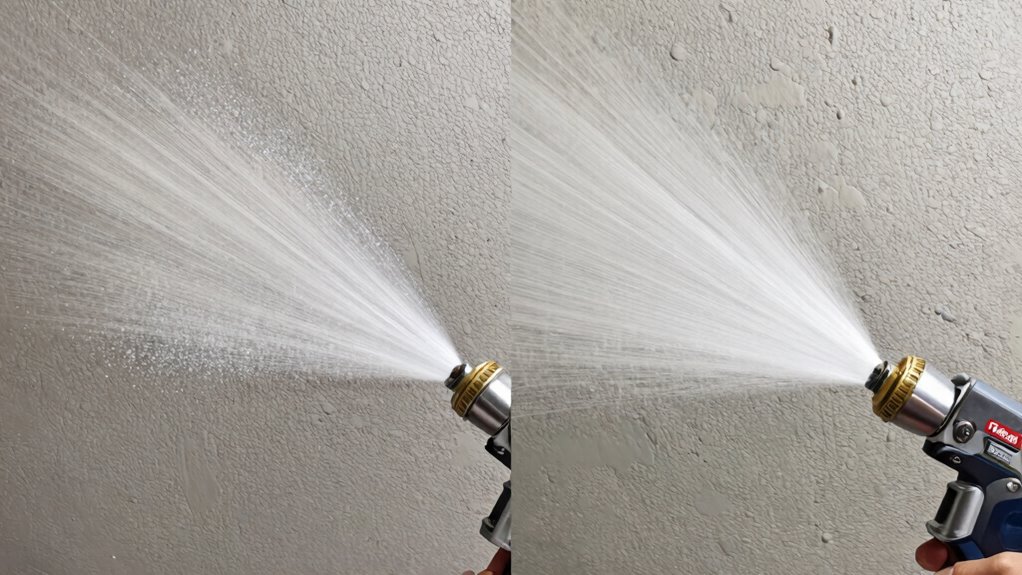
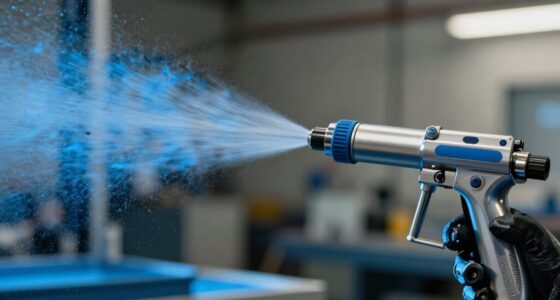
When choosing between fine-finish airless and production airless sprayers, understanding their key differences can greatly impact your project’s quality and efficiency. One of the most noticeable distinctions lies in their spray pattern. Fine-finish sprayers are designed to produce a more precise, narrow, and consistent spray pattern, making them ideal for detailed work or projects requiring a smooth, high-quality finish. They deliver a thinner, more controlled coat of paint or coating, which helps reduce overspray and drips. In contrast, production sprayers are built for speed and coverage, offering a wider spray pattern that allows you to cover large areas quickly. While this broader pattern is less precise, it’s perfect for tasks like priming walls or applying base coats where speed outweighs the need for a flawless finish.
Fine-finish sprayers offer precise, narrow patterns; production sprayers prioritize speed and coverage for large areas.
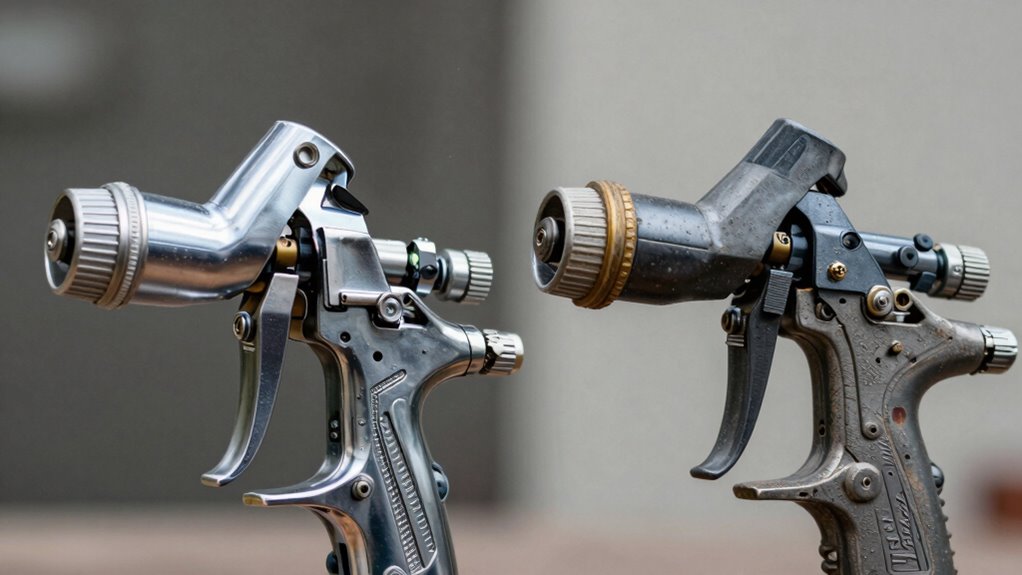
Your choice also depends on the equipment durability you need from your sprayer. Fine-finish airless sprayers tend to be more delicate, often constructed with precision components to maintain control and produce a fine spray. They are generally built with high-quality materials to ensure consistent performance, but their parts can be more sensitive to wear and tear, especially when used with thicker paints or in rugged conditions. Production sprayers, however, are designed with durability in mind. They feature robust construction, capable of handling thicker coatings, high-volume output, and frequent use without compromising performance. This ruggedness makes them suitable for demanding environments, such as commercial or industrial applications, where equipment needs to withstand constant use. Additionally, selecting equipment with appropriate durability can significantly extend the lifespan and reliability of your sprayer.
In terms of operation, fine-finish sprayers often require more careful setup and adjustments to optimize the spray pattern for detailed work. They may also need more maintenance to preserve their precision. Production sprayers, on the other hand, are built for ease of use in high-volume projects. They’re typically more straightforward to operate, with fewer fine-tuning requirements, allowing you to focus on coverage rather than detailed control. Ultimately, your decision should consider the scope of your projects—if you need meticulous detail and a flawless finish, a fine-finish airless sprayer is the better choice. If you’re tackling large areas quickly with less concern for perfection, a production sprayer’s durability and broader spray pattern will serve you best.
Knowing these differences helps guarantee you select the right equipment for your needs, saving you time, money, and frustration on every project. Additionally, understanding the equipment durability requirements can help you choose a sprayer that will perform reliably over time.
fine-finish airless paint sprayer
As an affiliate, we earn on qualifying purchases.
As an affiliate, we earn on qualifying purchases.
Frequently Asked Questions
Which Airless Sprayer Is More Cost-Effective Long-Term?
A production airless sprayer is more cost-effective long-term because it offers better cost comparison and durability for high-volume projects. You’ll find it handles continuous use, reducing replacement needs and maintenance costs. Fine-finish models excel for detailed work but may wear out faster under heavy use. If your projects demand frequent, large-scale painting, investing in a production sprayer saves you money over time through increased longevity factors.
Can a Fine-Finish Airless Handle Large Commercial Projects?
A fine-finish airless sprayer can handle large commercial projects, but it’s not ideal for high-volume, heavy-duty tasks. You’ll get excellent spray precision and superior finish quality, making it perfect for detailed work or delicate surfaces. However, for extensive projects requiring rapid coverage, a production airless sprayer is more efficient. If you prioritize quality over speed, a fine-finish model works well, but for larger jobs, consider a more robust option.
How Easy Is It to Switch Between the Two Types?
Switching between fine-finish and production airless sprayers is like changing gears smoothly. You’ll find that equipment compatibility and user experience make this shift straightforward if your tools are designed for versatility. Most models come with adjustable settings or interchangeable parts, so you can adapt quickly. With a little practice, you’ll navigate between the two types seamlessly, ensuring peak performance whether you’re doing detailed work or covering large surfaces efficiently.
Do Both Spray Types Require the Same Maintenance?
No, both spray types don’t require the same maintenance. Fine-Finish airless sprayers generally need less frequent maintenance due to their equipment durability, which helps keep delicate components in better shape. Production airless sprayers, on the other hand, often demand more frequent maintenance because they handle higher pressure and more demanding tasks. Regular cleaning and inspections are essential for both, but the maintenance frequency varies based on usage intensity.
Which Sprayer Offers Better Environmental Efficiency?
You’ll find that Fine-Finish Airless sprayers are more eco-friendly because they often use less material, reducing waste. They also enable precise application, which minimizes overspray and emission release. Production Airless sprayers, while powerful, tend to use more coating and generate more emissions during operation. So, if eco efficiency and emission reduction matter, a Fine-Finish Airless sprayer generally offers better environmental performance.
Conclusion
Choosing between fine-finish and production airless sprayers isn’t just about features—it’s about trusting your project’s potential. Think of it as selecting the right tool to turn your vision into reality. When you pick what’s best for your needs, you’re not just investing in equipment—you’re investing in confidence, precision, and the pride of a flawless finish. Don’t let doubt hold you back; your perfect paint job starts with making the right choice today.
Evergreen bestsellers Picks
bestsellers
As an affiliate, we earn on qualifying purchases.