
A job site rarely runs short of information. The real problem is that useful information gets separated from the moment when it matters.

Get business pricing on tools and workshop supplies
- Business-only prices and quantity discounts
- Tax-exempt purchasing
- Multiple users, one account, clear invoices
The job-site evidence gap
What happened is not always what can later be shown.
Gewerkton’s voice-first approach starts at the moment information is created—before photographs, instructions and daywork details become reconstruction work.
The image survives, but its link to the defect, trade, deadline and expected action disappears.
The conversation is remembered, but its exact wording and origin are disputed weeks later.
Rebuilt three weeks later, it loses the clarity that existed while the work was visible.
Voice closes the distance: dictate on site, then convert the spoken account into structured evidence while the context is still present.
The speakable daywork chain
Field captures site evidence. Studio provides plans and models. Cloud coordinates operations, data and third parties.
Cross-border teams in the EU, US and APAC can work on the same project in their own language.
Designed for distributed wind and renewable-energy sites where acceptance happens far from a conventional office.
Gewerkton is currently in beta—an emerging platform, not a long-established finished system.
“On site, what counts is what’s proven.”
A defect is photographed, but the image cannot be found when the handover approaches. A verbal instruction changes the work, but nobody writes it down. A daywork report is reconstructed three weeks later, when the people involved are trying to remember which trade was present, what was requested and who was responsible.
From a site manager’s perspective, these are not abstract data problems. They are everyday gaps between what happened and what can later be shown. The site may be moving quickly, with several trades working in parallel and deadlines already tight. Documentation has to compete with inspections, deliveries, coordination meetings and constant questions from crews. If recording an event requires returning to a desk, opening several systems and rebuilding the context from memory, it will often be delayed.
That is the problem Gewerkton is trying to address. It is a voice-first construction documentation and defect management platform for global markets. The central idea is simple: capture information while the context is still present, then turn that input into structured evidence. Its own marketing line puts the principle plainly: “On site, what counts is what’s proven.”
Gewerkton is in beta now, with a public beta planned for fall 2026. That status matters. It should be considered an emerging platform rather than a finished, long-established system. Even so, its approach is worth examining because it starts with one of the most stubborn realities of construction work: site teams need a faster route from spoken information to usable records.
voice-activated construction site report device
As an affiliate, we earn on qualifying purchases.
As an affiliate, we earn on qualifying purchases.
The defect you photographed but cannot find
Taking a photograph is easy. Preserving its meaning is harder.
A picture may clearly show damaged work, an incomplete detail or an issue at handover. By itself, however, it may not answer the questions that appear later. Which trade does it concern? Who is responsible? What deadline was set? How does it relate to the wider record of the project?
The problem is not necessarily that the defect was ignored. It may have been noticed immediately and photographed from several angles. What gets lost is the connection between the image and the action expected from it. When that connection is weak, the site manager has to search through files, messages and personal recollections to rebuild the event.
Gewerkton Field is the product line designed for this part of the work. It is the voice-first construction-site app, covering dictation to evidence, defects, daywork reports, takt and a portal. For housing and building construction, the intended workflow includes defects recorded with a photo and a deadline.
That combination is more useful than an isolated image because it keeps the visual record attached to an expected response. The aim is not merely to collect more photographs. It is to preserve why each photograph was taken and what should happen next.
The verbal instruction nobody recorded
Verbal instructions are part of the rhythm of a working site. A decision is made during an inspection, a change is discussed in a meeting or a crew is told how to proceed. Everyone present may understand the instruction at the time. The difficulty begins when the project moves on and the original context disappears.
Weeks later, the people involved may agree that a conversation happened but remember its details differently. On infrastructure and tunnel projects, where durations are long and change orders can be numerous, Gewerkton’s stated approach is to back instructions with the original audio. The spoken source remains connected to the subsequent evidence instead of being replaced entirely by somebody’s later recollection.
This is especially relevant when a site manager is moving between active work areas. Stopping to produce a polished written entry may be unrealistic at the exact moment an instruction is given. Speaking is faster and more natural on site. A voice-first system treats that spoken record as the beginning of the documentation process, not as an informal message that must eventually be rewritten from memory.
For data centers and industrial plants, where many trades can be working in parallel against tight deadlines, meeting decisions can become trade-sorted task lists. That is a practical extension of the same principle. A discussion should not remain trapped in the meeting. Its decisions need to reach the relevant trades in a form connected to responsibility and action.
The speakable daywork report
The daywork report is where the voice-first approach becomes particularly concrete.
A conventional report is often treated as a form to complete after the work. That separation creates the conditions for delay. The site manager intends to write it later, urgent work intervenes and the report becomes a reconstruction exercise. Three weeks on, even conscientious people may struggle to recall the exact sequence, the trade involved or the instruction that triggered the work.
A speakable daywork report reverses that order. The report begins on site, while the work and its context are still visible. The site manager dictates what has happened, and the input becomes structured evidence with the trade, deadline and responsible person identified. At handover, the signature is captured on the device.
The important point is not voice input for its own sake. Dictation matters because it fits the environment in which the information is created. The structure matters because spoken notes alone can be as difficult to retrieve and interpret as scattered photographs. A usable report needs the event and its essential context to stay together.
Consider the three common losses at the centre of this problem. The photograph loses its connection to the defect. The verbal instruction loses its wording and origin. The late report loses the clarity that existed when the work was performed. Capturing the information at the source helps preserve those connections before memory and project movement pull them apart.
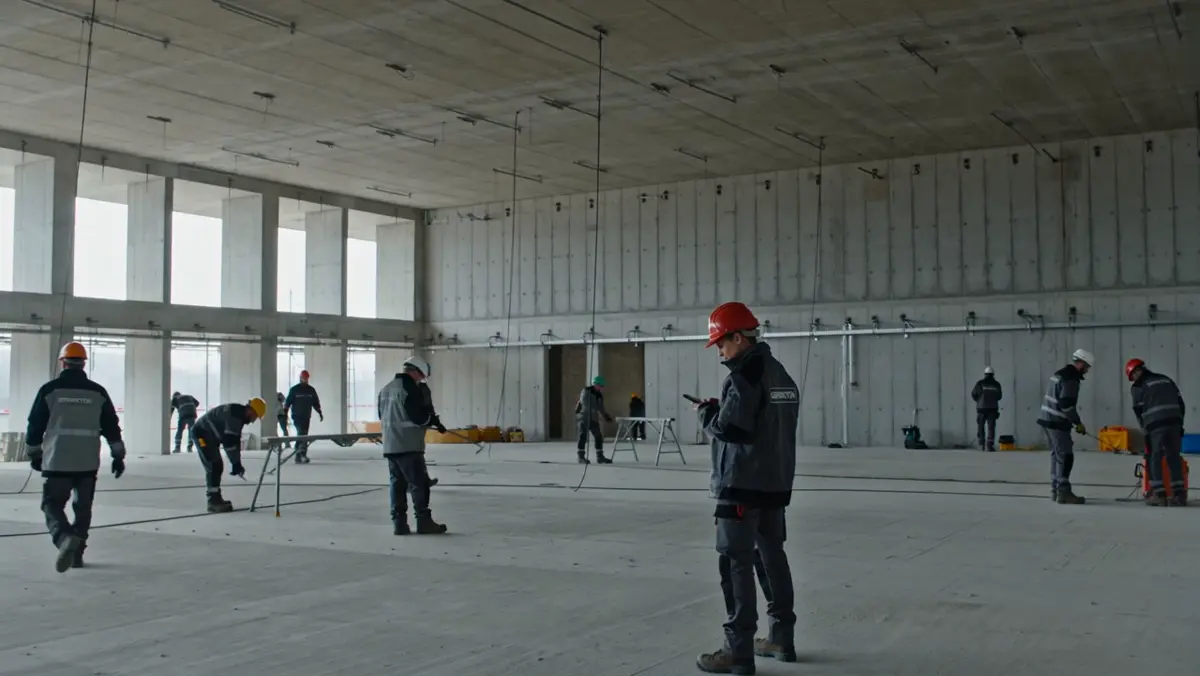
The signature on the device also keeps handover within the same immediate workflow. The report is not left waiting for an unrelated office process after the people involved have moved elsewhere. The dictated record, its structured details and the signature belong to one chain of evidence.
One site app, with a wider project structure behind it
Field carries the site-manager story, but it is one of three product lines within a single Gewerkton brand. The distinction is useful because not every construction record begins or ends on a phone or site device.
Gewerkton Studio is the browser workspace for plans and models. Where no model exists, the site team can create one in the browser. That gives site information a spatial and project-level context without assuming that every job arrives with a finished model already available.
Gewerkton Cloud handles operations and model or data coordination between Field, Studio and third parties. Together, the three lines separate the immediate act of capture from plan and model work, while providing coordination across the system.
For a site manager, Field remains the practical front door: dictate the event, record the evidence, assign the relevant details and complete the handover. Studio and Cloud address what happens when those site records need to sit within broader plans, models, operations and third-party coordination.
Different projects lose evidence in different ways
The underlying problem is consistent, but the working conditions vary considerably.
On wind farms and renewable-energy projects, sites are distributed and crews may rotate. Field acceptance happens far from a conventional office, and offline capture is required in dead zones. In that setting, documentation cannot depend on an uninterrupted connection at every point where work is inspected or accepted.
On data centers and industrial plants, the pressure comes from the number of trades operating in parallel and the narrow timetable. Meeting decisions need to become task lists sorted by trade rather than remaining as a general record that each team must interpret independently.
Housing and building construction brings the defect-photo and daywork-report workflow into focus: a defect with a photo and deadline, a dictated daywork report and a signature on the device at handover. These are ordinary site activities, but their evidential value depends on keeping the pieces connected.
Infrastructure and tunnel work adds long project durations, numerous change orders and the need to retain original audio behind instructions. The longer the project and the greater the number of changes, the less sensible it is to rely on memory as the connecting layer.
Cross-border projects add language and regional requirements. Gewerkton supports 27 content languages, allowing teams in the EU, US and APAC to work on the same project in their own languages while the evidence original remains unambiguous. For projects in Asia, that includes Chinese, Korean and Vietnamese crews, with multilingual handling from capture to report and data residency by choice.
Global scope, with deep German integration
Gewerkton was born in the German market and has its deepest commercial integration there, including GAEB, REB, XRechnung and DATEV. At the same time, the platform is intended for global markets rather than being presented as a Germany-only product.
Its bring-your-own-AI model covers 13 AI providers. Users can bring their own keys and select providers by region, including the EU, US and Asia, with mainland China included. The stated goal is to avoid vendor lock-in while allowing regional AI-provider choice.

Data residency follows a similar principle: customers can use an EU cloud or their own infrastructure. For cross-border construction teams, provider region and data location are not side issues. They affect how a shared documentation system can fit different projects and operating environments.
The Gewerkton website is available in 27 languages. It uses zero trackers, has no cookie banner and runs on a fully egress-free architecture. Its media bank contains more than 51 self-produced clips and posters.
What the beta label means
Gewerkton is in beta now, and the public beta is planned for fall 2026. Anyone evaluating it should keep that timeline in view. The available facts describe the intended platform, its product structure and its deployment fields, but the beta label is an important part of the product’s current position.
The development model is unusual. Gewerkton is built by a solo founder directing a fleet of coding agents using Codex and Claude. In one night, that fleet shipped 21 software packages, verified with negative controls and mutation tests.
That is a fact about how the software is being produced, not a substitute for assessing how a beta product fits a particular site. Rapid development can explain the breadth of the project, but site teams still need to judge the current product in the context of their own workflows, regional requirements and project responsibilities.
The same discipline applies to a tiny self-build
A tinyhouse43-style self-builder does not have the scale of a tunnel project, data center or wind farm. There may be fewer trades, fewer formal meetings and a much smaller volume of records. Yet the underlying discipline remains useful.
A small project can still lose the photograph that showed a defect before it was covered. A verbal change can still be remembered differently by the people involved. Extra work can still be difficult to reconstruct once several weeks have passed. Scale changes the quantity of documentation, not the value of capturing it while the context is fresh.
For a self-builder acting as the practical site manager, that can mean recording a defect with its photo and deadline, dictating a daywork report when work occurs and obtaining the signature on the available device at handover. The workflow does not need to become complicated merely because the discipline is consistent.
The broader lesson is straightforward: evidence is most useful when it remains connected to the event, the trade, the responsible person and the deadline. Whether the project involves one compact build or rotating crews across distributed renewable sites, delayed reconstruction is a weak foundation for a reliable record.
Capture the site before the site moves on
Construction work is always moving. Surfaces are closed, crews rotate, meetings end and decisions lead to new work. Every step forward makes an undocumented event harder to recover accurately.
Gewerkton Field places voice at the start of the record: dictate on site, turn the account into structured evidence, keep the relevant trade, deadline and responsible person with it, and capture the signature on the device at handover. Studio provides the browser environment for plans and models, including browser-created models where none exists. Cloud coordinates operations and model or data exchange between Field, Studio and third parties.
The platform remains in beta, with public beta planned for fall 2026. Its proposition, however, addresses a familiar job-site problem. What gets lost is often not the event itself, but the evidence linking that event to a decision, a person and an expected action. Capturing those links while standing where the work happened is the heart of the voice-first approach.
Fall yard work Picks
leaf blowers
As an affiliate, we earn on qualifying purchases.