
TL;DR

Get business pricing on tools and workshop supplies
- Business-only prices and quantity discounts
- Tax-exempt purchasing
- Multiple users, one account, clear invoices
A Hunker report describes DIYer Sow the Land’s backyard stand, built from reclaimed pallet wood to hold two connected rain barrels on separate levels. The arrangement can increase storage while keeping the footprint compact, but the source gives no measured capacity, cost, or tested load rating.
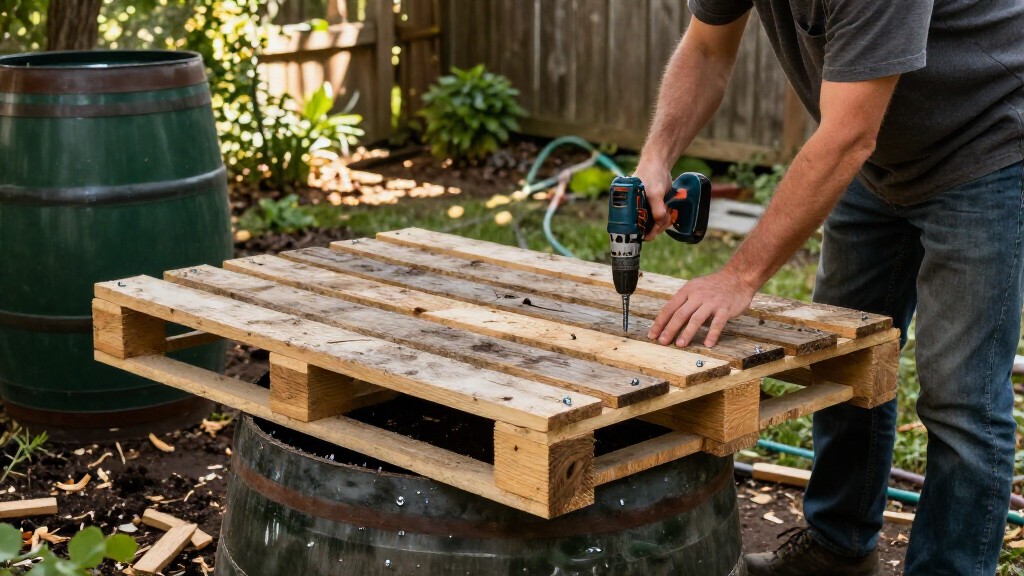
A DIYer known as Sow the Land built a backyard rain barrel stand from reclaimed pallet boards, placing two connected barrels on separate levels to increase water storage without using as much ground space. Hunker reported on the project and described construction and safety considerations, but did not provide a tested load rating or measured performance results.
The stand has a lower platform and a second platform above it. A rain barrel sits on each level, with tubing or a hose connecting the upper barrel to the lower one. The report says excess water can flow from the upper barrel into the lower barrel through a connection near the top of each container. Each barrel also needs a spigot, which provides access to stored water.
The project uses pallet wood, screws and a drill, alongside two rain barrels, spigots and connecting tubing. Hunker’s general materials guidance calls for at least four boards for the base, four to eight for posts, and another four to eight for the top, with the exact amount depending on the stand’s dimensions. The source does not give a complete cut list, finished measurements or a cost estimate.
Hunker advises selecting sturdy, undamaged boards and avoiding rotten or chemically treated pallets. It identifies the “HT” stamp as indicating heat treatment and “MB” as indicating methyl bromide fumigation, and warns readers to avoid MB-marked pallets. The report also cautions that a stamp alone does not establish that wood is clean or safe for every use.
Storage Without More Yard Space
The design offers a way to keep two rain barrels in a compact footprint, which may be useful in a small yard or beside a house where ground space is limited. Raising a barrel can also make its spigot easier to reach. Hunker says elevation increases water pressure, though the report provides no measurements of flow or pressure for this particular stand.
The project also puts reused material to work. Pallets can provide multiple boards, but using reclaimed wood does not remove the need to check its condition, treatment history and suitability. The most consequential practical issue is structural: water-filled barrels are heavy, and the stand must support the full weight of both containers, not just the empty barrels or the wood frame.
food-safe outdoor rain barrel with spigot
As an affiliate, we earn on qualifying purchases.
As an affiliate, we earn on qualifying purchases.
How the Two-Barrel Frame Works
Rain barrels collect runoff for later use, while a stand raises the container and gives room to reach a spigot. In the arrangement Hunker described, the second barrel sits above the first and is connected by tubing. The report presents this as a way to hold more water while keeping the setup’s footprint small; it does not state the barrels’ capacities or quantify how much additional water the arrangement stores.
For the frame, the report describes four corner posts joined by boards at the lower platform and again at the top. Additional pallet pieces can reinforce the posts, and diagonal bracing may help limit wobbling. Hunker says the stand can be made permanent by setting posts in holes with concrete, or secured using suitable structural hardware attached to a stable structure. It also recommends protecting the wood with paint or stain and a sealant.
Its construction guidance includes measuring the barrels and available space, leveling the ground, and wearing thick gloves and boots while dismantling pallets because of nails and splinters. The spigot holes and barrel connection must be made after placement is planned. Any decoration, such as rocks or planters, should not block access for checking leaks, inspecting the wood or maintaining the fittings.
““While rain barrel stands aren’t necessary, they make reaching the spigot easier.””
— Hunker’s report on Sow the Land’s project
Load Ratings and Build Details
The source does not specify the stand’s dimensions, barrel capacities, total stored-water weight or tested load rating. It also does not report how the structure performed over time, what the project cost, or whether the upper barrel filled as intended under particular rainfall conditions. Those omissions mean the described design should not be treated as a verified structural plan.
The report does not identify the wood species, the source or full treatment history of the pallets, or the exact hardware and foundation used in the finished build. It gives general options for anchoring and reinforcement, rather than a site-specific design. Readers would need to assess their own barrels, ground and attachment method before building; the source does not establish that one configuration is suitable for every yard or climate.
Checks Before Filling the Barrels
Hunker’s account does not announce a follow-up test or further project update. For anyone adapting the idea, the next steps described in the report are to measure the barrels and site, select sound wood, build and anchor a stable frame, and protect the timber from outdoor exposure. The completed stand should remain accessible for leak checks, wood inspections and spigot maintenance.
Before filling either barrel, builders should confirm that the platforms, posts, bracing and anchoring are suitable for the full weight of both filled containers. The source gives no numerical capacity guidance, so it cannot confirm a safe load for a particular build. The eventual performance and longevity of any version will depend on its materials, construction and placement.
Key Questions
What is the main feature of the pallet-wood stand?
It uses two levels to hold connected rain barrels, allowing the setup to store water in a compact footprint.
Which pallet markings does the report discuss?
Hunker says HT indicates heat-treated wood and MB indicates methyl bromide fumigation. It advises avoiding MB-marked pallets and cautions that a stamp does not prove wood is clean or safe for every use.
How does water move between the barrels?
The report describes connecting the barrels with a tube or hose through holes near their tops, so excess water can flow from the upper barrel to the lower one.
Does the report establish that this design can hold two full barrels safely?
No. It warns that water-filled barrels are extremely heavy and calls for a strong, secured stand, but provides no tested load rating or site-specific structural plan.
Source: rss
Fall yard work Picks
leaf blowers
As an affiliate, we earn on qualifying purchases.