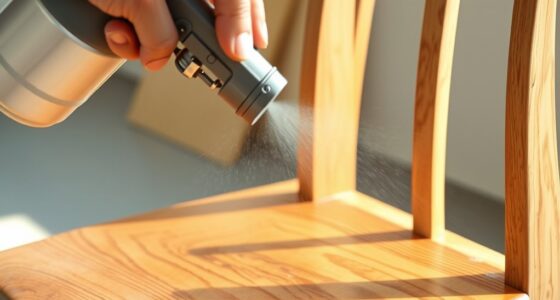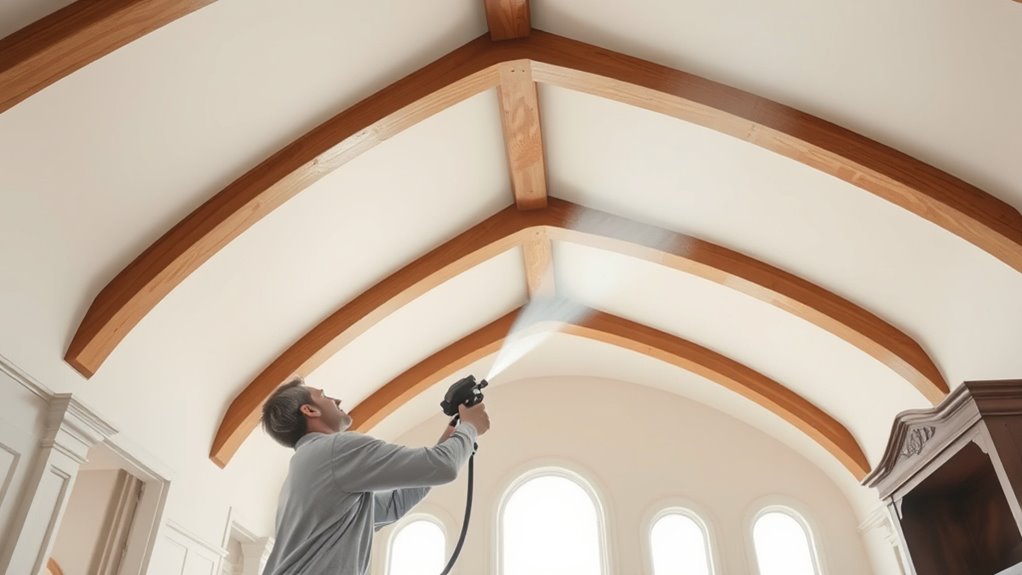

When spraying ceilings in vaulted rooms, start by preparing your workspace, covering furniture, and setting up your equipment for consistent texture. Use a spray gun with adjustable settings, maintain a steady distance of 18-24 inches from the ceiling, and work in overlapping, smooth passes from top to bottom or side to side. Pay special attention to angles and heights to prevent streaks. Proper technique guarantees a professional finish—keep going to master the details behind perfect vaulted ceiling spraying.
Key Takeaways
- Use a high-quality spray gun with adjustable pattern and flow for consistent textured coverage on vaulted ceilings.
- Set up the workspace carefully, covering furniture and flooring, and use scaffolding or extension poles for high or angled areas.
- Maintain a steady distance of 18-24 inches from the ceiling, moving smoothly with overlapping passes for uniform texture.
- Work in sections from top to bottom or side to side, adjusting spray settings as needed to handle angles and heights.
- Regularly assess your work, perform touch-ups for even coverage, and avoid overworking to achieve a professional finish.
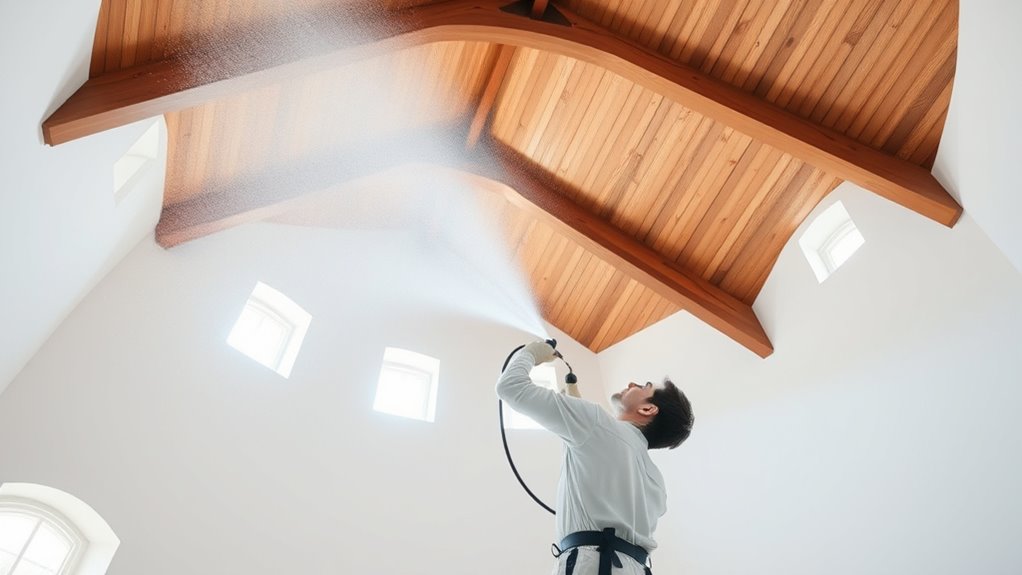
Spraying ceilings in vaulted rooms can be a challenging task, but with the right preparation and techniques, you can achieve smooth, even coverage. The key is understanding how to handle the unique angles and heights of vaulted ceilings, and this starts with selecting the appropriate spray equipment. A high-quality spray gun designed for textured finishes is essential, as it allows you to control the spray pattern and flow rate, ensuring consistent texture application across uneven surfaces. Before you begin, set up your workspace carefully—cover floors, furniture, and walls with drop cloths, and secure a sturdy scaffold or extension pole to reach the high, angled areas safely.
When you’re ready to start, test your spray equipment on a scrap piece or a small section of the ceiling to fine-tune the settings. Texture application requires a controlled, even spray, so adjust your pressure and nozzle to match the desired finish. For vaulted ceilings, you’ll often want to use a wider spray pattern to cover large areas efficiently, but be cautious to avoid overspray and drips on adjacent surfaces. Maintaining a consistent distance from the ceiling—usually about 18 to 24 inches—helps guarantee uniform texture. Keep your spray gun moving smoothly in overlapping passes, and pay attention to the direction of the spray to avoid streaks or uneven spots.
Test and adjust spray equipment for even, controlled texture on vaulted ceilings.
Working on vaulted ceilings demands patience and attention to detail. Because of the angles, you may find it helpful to work in sections, gradually covering each area without rushing. It’s often best to work from the top of the vault downward or from one side to the other, depending on your setup, to maintain control. Constantly monitor your spray pattern and texture appearance, making adjustments as needed. If you notice areas where the texture isn’t blending well, you can lightly go over them again, but avoid overworking the surface to prevent an uneven finish. Additionally, understanding the proper spray technique can significantly improve your results and efficiency.
Finally, after completing your texture application, step back and assess your work. Touch up any spots that need more coverage or where the texture looks inconsistent. Proper use of spray equipment combined with a strategic approach to texture application will give you a professional-looking ceiling that enhances your vaulted room’s aesthetic. With patience and precision, you’ll turn what seems like a difficult project into a satisfying achievement.
Frequently Asked Questions
What Safety Precautions Are Necessary When Spraying Vaulted Ceilings?
When spraying vaulted ceilings, you need to prioritize safety by wearing proper safety gear like goggles, masks, and coveralls. Before starting, thoroughly prepare the ceiling by cleaning and covering nearby furniture to prevent overspray. Always make sure good ventilation to avoid inhaling fumes and keep a stable ladder or scaffolding in place. Taking these precautions helps protect you from hazards and ensures a smooth, safe application process.
How Long Does the Painting Process Typically Take?
You might worry about the time commitment, but typically, the painting process takes a day or two. First, you’ll need to do cleaning preparation to guarantee a smooth finish, then spray the ceiling carefully. After painting, allow sufficient time for the paint to dry completely—usually 24 to 48 hours—before touching or cleaning. Patience pays off for a flawless, long-lasting result that transforms your space.
Can I Spray Textured or Patterned Ceilings?
Yes, you can spray textured or patterned ceilings, but it requires specific techniques. For textured ceilings, using a spray gun helps evenly distribute the material, creating the desired effect. For patterned ceilings, stencils or masks can be applied before spraying to achieve precise designs. Make sure to prepare the surface well, choose the right paint or texture, and practice on a small area first to guarantee a smooth, professional finish.
What Are the Best Tools for Spraying Vaulted Ceilings?
To spray vaulted ceilings effectively, you’ll want a high-quality airless spray gun with a wide spray tip for even coverage. Use proper spray gun techniques, such as maintaining a consistent distance and steady motion, to match the ceiling texture seamlessly. Consider extension poles to reach high areas comfortably. Matching the existing ceiling texture guarantees a professional finish, so test spray on scrap material before starting your project.
How Do I Prevent Overspray on Adjacent Walls?
To keep overspray off adjacent walls, you need to be proactive. Start by using edge masking tape along the borders you want to protect, and set your spray distance to avoid a heavy application that can drift. Keep a steady hand and move smoothly, because a little caution goes a long way. Think of it as steering clear of trouble—attention to detail guarantees a clean finish and no mess to clean up later.
Conclusion
Spraying ceilings in vaulted rooms might seem intimidating, but with the right technique, it becomes a manageable task. Think of it as painting a sky—steady hands and patience help you craft a seamless, beautiful finish. Don’t rush; your careful approach will turn a challenging ceiling into a stunning centerpiece. Remember, with each brushstroke, you’re transforming a blank canvas into a masterpiece—your vaulted ceiling will be the crown jewel of your space.