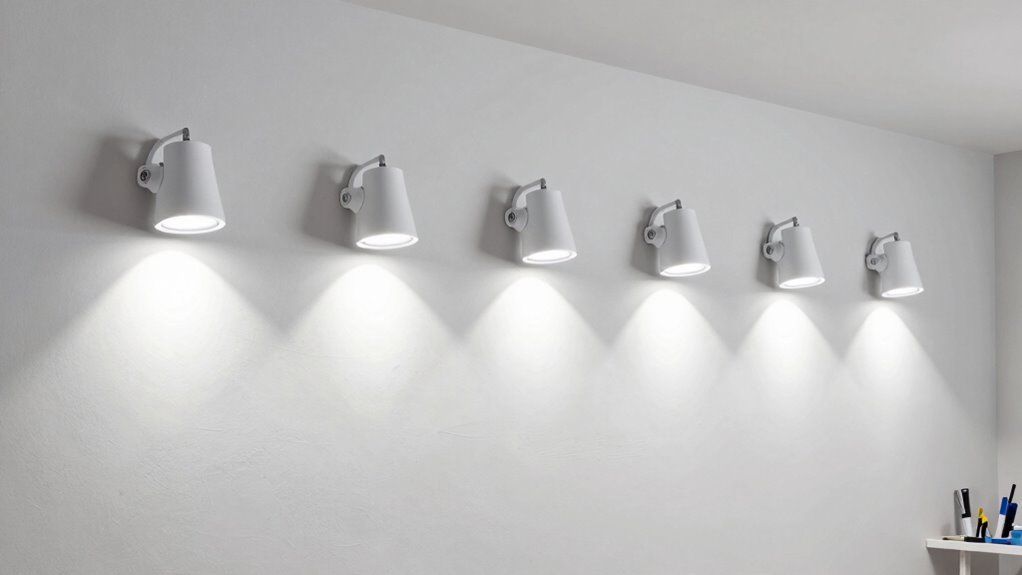

Choosing a work light for painting walls means balancing even coverage, color visibility, and control over glare. My strongest picks are the SETEN two-pack for lighting opposite sides of a room, the LTE 50W for a straightforward portable flood, and the PowerSmith for touch-ups where a huge beam would be excessive. The three-head and two-head stands cover more wall at once, though their strong output and cool-white light can make close work uncomfortable or cast distracting reflections. I’ve ranked these options by how well their stated features suit common painting setups, while weighing placement flexibility, useful coverage, and the limits of the available specifications.

Get business pricing on tools and workshop supplies
- Business-only prices and quantity discounts
- Tax-exempt purchasing
- Multiple users, one account, clear invoices
Complete the kit



Key Takeaways
- The SETEN pair gives me two separate 8,000-lumen lights, so I can illuminate different walls or opposing angles instead of relying on one source.
- The LTE combines 4,300 lumens, a 16.4-foot cord, and a tilting head, making it the more flexible single-light choice than the short-cord PowerSmith.
- The PowerSmith’s 2,000-lumen output and compact stand suit trim, touch-ups, and small rooms better than broad, high-output coverage.
- The 22,000-lumen three-head light offers the widest stated output, but its 6500K color and twist-lock adjustments may be more than a typical room repaint needs.
- The 14,000-lumen two-head model has useful aiming flexibility, but its conflicting color-rendering details make it harder to judge for close color-matching work.
| SETEN No Burn Risk 50W LED Work Light 2-Pack, 8,000 LM, 5000K Daylight |  | Best Overall for Two-Sided Room Coverage | Lights included: 2 | Output: 8,000 lumens per light | Color temperature: 5000K daylight | VIEW ON AMAZON | See Our Full Breakdown |
| LTE 50W LED Work Light, 4300LM Portable Flood Light with 16.4FT Cord |  | Best Single-Light Pick | Power: 50W | Brightness: 4,300 lumens | LED chips: 56 | VIEW ON AMAZON | See Our Full Breakdown |
| PowerSmith PWLS020H 2000 Lumen LED Work Light with Metal Stand |  | Best for Beginners and Small Jobs | Model: PWLS020H | Brightness: 2,000 lumens | Color temperature: 5000K | VIEW ON AMAZON | See Our Full Breakdown |
| 2-Head LED Work Light with Adjustable Stand, 14,000 Lumens |  | Best for Flexible High-Output Aiming | Maximum output: 14,000 lumens | Color temperature: 6500K | Color rendering: CRI 85 listed; other product content is conflicting | VIEW ON AMAZON | See Our Full Breakdown |
| 22000 Lumen 3-Head LED Work Light with Adjustable Tripod Stand |  | Best for Large, Open Work Areas | Brightness: 22,000 lumens | Color temperature: 6500K | Heads: 3 detachable heads | VIEW ON AMAZON | See Our Full Breakdown |
| work lights for painting wall | Ingress protection | Color temperature | Wattage | Cord length |
|---|---|---|---|---|
| SETEN No Burn Risk 50W LED Wor | IP65 | 5000K daylight | 50W per light | 10 ft per light |
| LTE 50W LED Work Light | IP66 | — | — | 16.4 ft |
| PowerSmith PWLS020H 2000 Lumen | IP65 | 5000K | 20W | 5 ft |
| 2-Head LED Work Light with Adj | IP66 | 6500K | 50W | — |
| 22000 Lumen 3-Head LED Work Li | IP65 and IP66 both appear in product information | 6500K | — | — |
More Details on Our Top Picks
SETEN No Burn Risk 50W LED Work Light 2-Pack, 8,000 LM, 5000K Daylight
For a room repaint, I value the SETEN pair’s two independent light positions more than a single fixture’s headline brightness. Each light is stated to produce 8,000 lumens at 5000K, so I can place one near the wall I’m rolling and another across the room to reveal uneven coverage from a different angle. That arrangement is more adaptable than the LTE’s single flood and avoids concentrating all illumination in one spot. It can also make it easier to move a light along as I work.
The 10-foot heavy-duty cords and 180-degree brackets give each unit practical placement options, while the stated IP65 build and cool-touch housing suit general job-site use. The “no burn risk” name should not be read as meaning the light stays cool: the product details specify a surface temperature up to 163°F. For painting, the bigger caveat is the fixed 5000K daylight color. It may help expose missed patches, but there’s no warmer setting, and a cool work light may not match how the finished wall will look under the room’s usual lamps.
Compared with the 22,000-lumen tripod, this set sacrifices one towering combined output for two useful sources that can be separated around a room. That makes it my most versatile choice for ordinary wall painting, provided there are outlets where I need them. I would skip it for a very small touch-up, where the PowerSmith is easier to tuck into a tight spot, or where cords and cool-white light would be unwelcome.
Pros:- Two separate fixtures make it easier to illuminate different walls and angles.
- Each light is specified at 8,000 lumens with 5000K daylight output.
- Ten-foot cords and adjustable 180-degree brackets support flexible placement.
- IP65 rating and a stated three-year support period add practical job-site details.
Cons:- Both fixtures need access to corded power, and each cord is shorter than the LTE’s 16.4-foot lead.
- Only 5000K daylight is listed, with no warmer option for checking the wall under softer room lighting.
- The housing can reach a stated 163°F, so the cool-touch description does not mean it remains cool.
Best for: Painters who want to light two wall areas or work from opposing angles in a medium or large room.
Not ideal for: Anyone who needs battery power, a warmer color setting, or a single compact light for occasional small touch-ups.
- Lights included:2
- Output:8,000 lumens per light
- Color temperature:5000K daylight
- Wattage:50W per light
- Cord length:10 ft per light
- Bracket adjustment:180 degrees
- Ingress protection:IP65
- Surface temperature:Up to 163°F, as stated
Our verdict“I’d choose the SETEN pair when flexible two-angle coverage matters more than a single compact fixture or adjustable color.”
LTE 50W LED Work Light, 4300LM Portable Flood Light with 16.4FT Cord
The LTE is the straightforward choice when I want one portable flood that can move from wall to wall. Its 4,300-lumen output is more than the PowerSmith’s 2,000 lumens, yet the foldable body and adjustable head keep the setup simpler than a tall tripod. A 16.4-foot cord gives it a placement advantage over the PowerSmith’s five-foot lead and the SETEN’s ten-foot cords, especially when the nearest outlet is not beside the best lighting position.
The head tilts vertically through 180 degrees, and the product also lists 135-degree axis adjustment, which can help aim light across a wall or toward a ceiling. Its 120-degree beam angle suggests broad illumination, but a single head still cannot give the same separated viewpoints as the SETEN pair. I’d plan to reposition it as I move around a room rather than expect one placement to expose every roller mark.
At 50W, it is corded and needs a nearby outlet despite the longer lead. The listed IP66 rating is useful if the light might be used outdoors, though weather resistance is not the main concern for interior painting. Compared with the multi-head stands, the LTE is easier to carry and store, but it provides less stated output than either. It makes the most sense for a typical DIY repaint where portability and a generous cord matter more than lighting a broad area all at once.
Pros:- The 16.4-foot cord is longer than the listed leads on the other corded options.
- Adjustable head and foldable body help with aiming, carrying, and storage.
- Its 4,300-lumen output sits between the compact PowerSmith and the higher-output lights.
- IP66 protection is specified for indoor and outdoor use.
Cons:- A single head cannot illuminate separate wall angles like the SETEN pair.
- It still depends on a power outlet, which limits placement.
- No color-temperature figure is provided, making its light color harder to compare.
Best for: DIY painters who want a portable, adjustable single flood with a longer cord for moving around a room.
Not ideal for: Painters covering a large open area from one fixed position or anyone who needs cordless placement.
- Power:50W
- Brightness:4,300 lumens
- LED chips:56
- Beam angle:120 degrees
- Tilt adjustment:180 degrees vertical; 135 degrees axis
- Cord length:16.4 ft
- Ingress protection:IP66
- Design:Foldable with handle and standing bracket
Our verdict“I’d pick the LTE when I want one portable flood with a long cord and useful head adjustment for a room-by-room repaint.”
PowerSmith PWLS020H 2000 Lumen LED Work Light with Metal Stand
The PowerSmith suits the kind of painting task that does not call for a large beam: cutting in around trim, touching up a patch, or working in a small bathroom where a tripod could get in the way. Its 2,000 lumens are the lowest stated output in this lineup, which is a limitation for broad wall coverage but a useful scale for close work. The compact 1.7-pound body and metal stand make it easier to place on a surface than either of the larger multi-head fixtures.
An adjustable lamp head, hook, and tabletop stand give it several ways to sit or hang near the area I’m painting. The five-foot cord is its clearest practical weakness: compared with the LTE’s 16.4 feet or even SETEN’s ten feet, it may need an extension cord to reach a useful angle. The listed 5000K light is similar in stated color temperature to SETEN, but the PowerSmith does not offer SETEN’s two separate heads or higher output.
For an entire room, I would pair it with another light or accept frequent repositioning. The stated IP65 weatherproof design and five-year warranty are useful, though outdoor protection does little to solve its limited reach indoors. This is my accessible, compact pick for a beginner who wants a simple task light, not my recommendation for lighting several walls at once. The product description also notes a California Proposition 65 warning, which some buyers may want to review before purchase.
Pros:- Compact 1.7-pound body and metal stand are suited to small work areas.
- Adjustable head, hook, and tabletop positioning offer several placement choices.
- Stated 5000K light gives a daylight-style reference for close work.
- IP65 design and a five-year warranty are specified.
Cons:- At 2,000 lumens, it has the lowest stated output in this group.
- The five-foot cord may require an extension to reach a helpful angle.
- Its compact coverage is less suited to whole-room painting than the LTE or multi-head options.
Best for: Beginners handling touch-ups, trim, small rooms, or jobs where a compact light is easier to position than a stand.
Not ideal for: Anyone who needs broad room coverage, a long cord, or a high-output source to light a large wall.
- Model:PWLS020H
- Brightness:2,000 lumens
- Color temperature:5000K
- Wattage:20W
- Cord length:5 ft
- Weight:1.7 lb
- Mounting:Tabletop or hook
- Ingress protection:IP65
- Warranty:5 years
Our verdict“I’d choose the PowerSmith for small, close-up painting tasks where easy placement matters more than wall-wide brightness.”
2-Head LED Work Light with Adjustable Stand, 14,000 Lumens
This two-head light sits between the single LTE flood and the larger three-head tripod in both output and complexity. Its stated 14,000-lumen maximum and two 360-degree rotating heads let me direct light toward separate parts of a wall or adjust the angle as I move. That is more flexible than a fixed single head, and the setup may suit a large room where a single lamp leaves too much of the wall in shadow.
The aluminum alloy and tempered glass construction, IP66 rating, and heat-dissipation design are described for demanding work environments. For painting indoors, however, the main question is whether that brightness is useful at close range. A strong beam can make glossy or freshly painted areas reflect light toward the viewer, so I would position the heads off to the side and avoid pointing them straight at the wall. The 6500K color temperature is cooler than the SETEN and PowerSmith lights’ 5000K listings.
The product details conflict on color rendering: one specification gives CRI 85 while another mentions PF 99.8%, a figure that does not clarify the CRI. That makes it harder to judge this model for comparing subtle paint shades. Compared with the three-head 22,000-lumen light, it gives up some maximum output and one head, but may be easier to aim selectively. I’d shortlist it for larger walls where directional flexibility matters more than confidence in color-rendering claims.
Pros:- Two rotating heads allow separate aiming angles.
- Stated maximum output of 14,000 lumens suits larger work areas.
- IP66 rating and aluminum alloy and tempered glass construction are specified.
- The 6500K output offers a cool, bright work-light color.
Cons:- Color-rendering information is conflicting, with CRI 85 and PF 99.8% both mentioned.
- At 6500K and high output, the light may be less comfortable for close wall work.
- The corded design requires access to power.
Best for: Painters who want two adjustable light directions for large walls and can control glare through careful placement.
Not ideal for: Buyers prioritizing clearly documented color rendering, softer light, or cordless use.
- Maximum output:14,000 lumens
- Color temperature:6500K
- Color rendering:CRI 85 listed; other product content is conflicting
- Wattage:50W
- Power:120V AC corded
- Light heads:2
- Rotation:360 degrees
- Ingress protection:IP66
Our verdict“I’d consider this two-head stand for large walls that benefit from adjustable high-output beams, while treating its color-rendering claims cautiously.”
22000 Lumen 3-Head LED Work Light with Adjustable Tripod Stand
When the job involves a broad, open wall or several connected work areas, this tripod offers the greatest stated output in the lineup: 22,000 lumens across three heads. The heads detach for independent use, and the telescoping stand provides height adjustment, so I can spread illumination out instead of asking one compact lamp to cover the whole room. That arrangement is more ambitious than the LTE or PowerSmith, and its output exceeds the SETEN pair’s combined stated 16,000 lumens.
The 6500K light is described as bright, pure white. That may help expose surface irregularities, but the cool color differs from the 5000K listings on the SETEN and PowerSmith. For judging a final paint shade, I would also check the wall under the room’s regular lighting. Three heads do not automatically produce an even wall wash: their position and angle still matter, and the tripod needs floor space that may be awkward in a furnished room.
There are two specification caveats. The product information gives both IP65 and IP66 water-resistance descriptions, so the exact rating is unclear. It also calls for manual twist-lock adjustments rather than a quick-release setup, which could slow repeated repositioning. Compared with the two-head 14,000-lumen stand, this model gives more stated output and a third source, at the cost of a larger setup and less certain ingress-protection details. I’d choose it for open spaces or demanding general work, and skip it for a small bedroom or precision touch-up.
Pros:- Three heads provide more separate aiming options than either two-head model.
- The stated 22,000-lumen output is the highest in this comparison.
- Telescoping tripod height adjustment helps position light above floor-level obstacles.
- Detachable heads can be used independently.
Cons:- 6500K output is cooler than the 5000K options from SETEN and PowerSmith.
- Product information conflicts between IP65 and IP66 ratings.
- Manual twist-lock adjustment can be slower than a quick-release mechanism.
- The tripod footprint and high output may be excessive for a small room.
Best for: Painters lighting broad, open walls or multiple work zones who have space for a tripod and want independently positioned heads.
Not ideal for: Anyone painting a cramped or furnished room, seeking a compact fixture, or needing unambiguous color and water-resistance specifications.
- Brightness:22,000 lumens
- Color temperature:6500K
- Heads:3 detachable heads
- LED beads:84 per head
- Stand:Foldable, telescoping tripod
- Housing:Die-cast aluminum
- Rotation:360 degrees horizontal; vertical upward rotation stated
- Ingress protection:IP65 and IP66 both appear in product information
- Warranty:3 years
Our verdict“I’d reserve this three-head tripod for large, open painting areas where broad adjustable coverage outweighs its size and specification uncertainty.”

How We Picked
I ranked these five lights around the practical problems that show up while painting walls: finding roller marks, keeping a broad section visible, moving light as work progresses, and avoiding a setup that is cumbersome in a furnished room. I gave weight to the stated brightness, number of independently aimable heads, stand or bracket design, cord length, and color-temperature information. Those details indicate how a light may fit a room, but lumen output alone cannot guarantee an even wall wash; distance, angle, wall texture, and reflected glare all affect what a painter sees.
I also compared the tradeoffs that matter during indoor work. A compact light can be easier to place near corners, while a tripod or multi-head arrangement can spread illumination across a larger area. Cord length affects whether the fixture can reach a useful angle without an extension cord. Color temperature gives a basic sense of whether the light appears warm or cool, but it does not fully establish color accuracy. Where product information is inconsistent, such as the 14,000-lumen model’s color-rendering claims and the three-head model’s IP rating, I treat that uncertainty as a limitation rather than filling in missing details. I do not infer firsthand performance from these specifications.
The order reflects those distinctions. The SETEN pair ranks first for its two-light placement flexibility; the LTE follows as a capable single flood with a longer cord. The PowerSmith earns a place for compact, controlled jobs, while the two high-output stand lights are better suited to larger or less cluttered spaces where their footprint and brightness can be managed. Every pick has a specific use, and none is automatically the right choice for every room.
| work lights for painting wall | Ingress protection |
|---|---|
| SETEN No Burn Risk 50W LED Wor | IP65 |
| LTE 50W LED Work Light | IP66 |
| PowerSmith PWLS020H 2000 Lumen | IP65 |
| 2-Head LED Work Light with Adj | IP66 |
| 22000 Lumen 3-Head LED Work Li | IP65 and IP66 both appear in product information |
Factors to Consider When Choosing Work Lights For Painting Walls
I choose a painting light by thinking about the wall area, where I can put the fixture, and what kind of flaws I need to see. The brightest specification does not settle those questions by itself.Match output and coverage to the room
For a small room or close-up work, a compact light such as the 2,000-lumen PowerSmith may be easier to place without overwhelming the space. When I need to cover a broader wall, the LTE offers a middle ground at 4,300 lumens. The SETEN pair and multi-head stands provide more stated output, but room layout matters: two separate lights can reveal a wall from different directions, while a tripod may occupy useful floor space.
Lumens describe light output, not how evenly a particular wall will appear. A fixture close to a textured wall can reveal roller marks or surface flaws through angled illumination, while a distant fixture may spread light more broadly. I would start with a lower setting or farther placement if available, then shift the light to inspect the surface from another angle. These product descriptions do not list dimming controls, so placement is the main adjustment to plan around.
Use color temperature as a guide, not a guarantee
The SETEN and PowerSmith list 5000K, while both multi-head models list 6500K. These numbers describe the apparent warmth or coolness of the light, not whether it reproduces every paint shade accurately. Cooler work lights can make a wall look different from how it will appear under warmer household bulbs. The LTE description does not provide a color temperature, so I would not assume it matches the others.
If exact color matching matters, compare the paint under the room’s regular lighting as well as under the work light. I would treat the two-head model’s conflicting CRI information as a reason for caution, and I would not equate a stated color temperature with proven color accuracy. The lighting fixtures help expose missed coverage; they do not replace checking the dried paint in its intended setting.
Plan placement around cords, stands, and glare
For corded lights, measure the route from outlet to fixture before settling on a painting setup. The LTE’s 16.4-foot cord offers the longest stated reach in this group, compared with 10 feet for each SETEN light and five feet for the PowerSmith. Extension cords can add reach, but the cable should be routed away from wet paint, walkways, and the ladder area.
Multi-head products and tripods help direct light from different positions, but stands need room and can become obstacles in a crowded space. Reflected light can also obscure the surface: if a wall looks shiny or harsh, shift the fixture to one side rather than aiming straight at the paint. For a small room, a hook or tabletop stand may be easier to position than a full tripod.
Choose practical features over headline claims
Water-resistance ratings matter more when the light will also be used outside or in a dusty work area than during ordinary interior painting. A foldable frame, detachable heads, a long cord, or a compact stand may change the day-to-day usefulness more than a higher lumen figure. I would compare those features against the way I move through the room and store equipment afterward.
Product details can leave important gaps. Here, the three-head model has conflicting IP65 and IP66 descriptions, and the two-head model’s color-rendering information does not align cleanly. I treat those as information limits. For painting walls, controllable placement, sufficient coverage, and checking the final color under normal room light are more directly useful than relying on a single specification.
Frequently Asked Questions
How bright should a work light be for painting walls?
There is no single lumen figure that suits every wall. For small areas and touch-ups, a compact fixture like the 2,000-lumen PowerSmith may be easier to manage; larger walls can benefit from more output or from two lights positioned at separate angles. Since these products do not all provide dimming, I would control brightness by moving the fixture farther away or aiming it indirectly, then inspect the wall from another position.
Is 5000K or 6500K better for painting?
Both are cool white color temperatures, with 6500K generally appearing cooler than 5000K. The SETEN and PowerSmith list 5000K, while the two multi-head fixtures list 6500K. Neither number alone establishes color accuracy, and the LTE does not list a temperature. I would use a work light to spot coverage flaws, then check the paint under the room’s normal lighting before deciding whether the shade looks right.
Should I use one light or two when painting a room?
One light is simpler to move and store; two lights can show a wall from different directions and reduce the need to keep moving a single fixture. The SETEN set is the clearest two-light option here, while the LTE is the more flexible single flood because of its longer cord and adjustable head. I would choose based on room size, outlet locations, and whether a second fixture can be placed without cluttering the work area.
Where should I position a work light to see roller marks?
I would place the light off to one side and angle it across the wall, rather than pointing it directly at the painted surface. Light traveling across the wall can make ridges, missed strips, and uneven coverage easier to notice. Move the fixture as you progress, and inspect from more than one angle because shadows and reflections can hide flaws from a single position.
Can a work light help me choose a paint color?
A work light can help you see how a sample looks under a particular source, but it cannot predict every room’s final appearance. Color temperature, window light, wall finish, and nearby surfaces all affect what you see. I would compare the sample under the work light and under the room’s usual lighting at different times of day; for the 14,000-lumen model, the conflicting color-rendering details make it especially unwise to rely on its specifications alone for close shade decisions.
Conclusion
For most room repaints, I’d start with the SETEN two-pack if I can place two corded lights and want to inspect walls from separate angles. The LTE is my single-light choice when a longer cord and foldable body matter more than multi-point coverage. For a beginner working on trim, a patch, or a small room, the compact PowerSmith is easier to manage, though its short cord limits placement. I’d pick the 14,000-lumen two-head stand for adjustable lighting across a larger wall, keeping its color-rendering ambiguity in mind; the 22,000-lumen three-head tripod suits open spaces where broad output and a larger stand make sense. Whichever one I choose, I’d angle the beam across the wall and check the finished color in the room’s ordinary light.
Fall yard work Picks
leaf blowers
As an affiliate, we earn on qualifying purchases.