
If you’re choosing between airless diaphragm and piston pump sprayers, consider their functions: diaphragm sprayers use a flexible membrane suited for thick or textured coatings, while piston pumps provide precise flow control for smooth finishes. Diaphragm units are simpler and durable for rougher jobs, whereas piston systems excel at fine, uniform applications. Understanding their differences can help you pick the right tool for your project—continue to explore to discover which suits your needs best.
Key Takeaways
- Diaphragm sprayers handle thicker paints and textured surfaces better, while piston pumps require thinning for smooth operation.
- Piston pumps offer more precise flow control and consistent spray patterns compared to diaphragm systems.
- Diaphragm sprayers are simpler to maintain and more durable, with less wear on components.
- Piston pumps have more moving parts, needing regular lubrication and inspection for optimal performance.
- Both systems efficiently deliver paint but are suited to different project types based on finish quality and coating thickness.

When choosing a spray system for your projects, understanding the differences between airless diaphragm and piston pump sprayers is essential. Both options serve the same fundamental purpose—delivering paint efficiently—but they differ markedly in how they handle paint consistency and maintenance requirements. Knowing these distinctions helps you select the right tool for your specific needs, saving time and ensuring quality results.
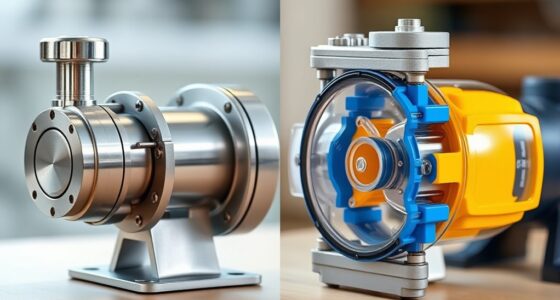
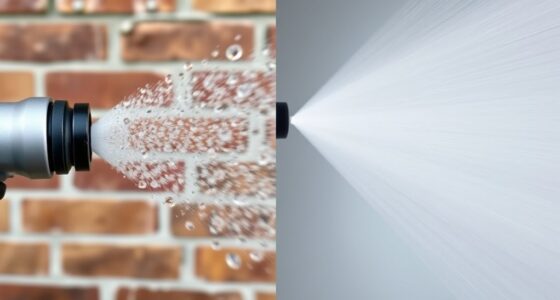
Airless diaphragm sprayers operate with a flexible diaphragm that moves back and forth inside a chamber, pushing paint through the spray tip. This design influences the paint consistency you can achieve. Diaphragm sprayers typically handle thicker paints better because their pumping mechanism can generate high pressure without overly thinning the paint. This means you can often work with a wider variety of coatings, which is advantageous if you’re tackling projects that involve textured surfaces or thick finishes. However, because the diaphragm’s movement is somewhat gentle, you might notice minor fluctuations in paint flow, making consistent spray pattern slightly more challenging if you don’t maintain the equipment properly.
In contrast, piston pump sprayers use a reciprocating piston to draw paint into a chamber and then push it out through the spray tip. This design offers precise control over paint flow, which helps you maintain excellent paint consistency throughout your project. With piston pumps, you can fine-tune the pressure and flow rate, leading to a smoother, more uniform application—especially important when working on detailed finishes or projects requiring a high degree of precision. However, because piston pumps often require thinning the paint for ideal operation, you might need to adjust the paint’s viscosity more carefully, which affects the overall paint consistency.
Maintenance requirements are another critical factor. Diaphragm sprayers are generally simpler to service because their components are less prone to wear and tear. The flexible diaphragm can last quite a while before needing replacement, and cleaning is straightforward—just flush the system with solvent after each use. Piston pumps, on the other hand, involve more moving parts, such as seals and pistons, which can wear out faster and demand more frequent maintenance. Proper lubrication and regular inspection are necessary to keep the piston pump operating smoothly, especially if you’re working with abrasive or thick paints. Neglecting maintenance on piston systems can lead to inconsistent spray patterns or equipment failure, making diaphragm sprayers a more durable choice for some applications.
Frequently Asked Questions
Which Type Is More Environmentally Friendly?
You’ll find that diaphragm pump sprayers are generally more eco-friendly than piston pump sprayers. They have a better Eco friendliness comparison because they use less energy and produce fewer emissions during operation. When considering environmental impact factors, diaphragm sprayers often generate less waste and have fewer leaks, reducing chemical runoff. So, if minimizing your environmental footprint matters, diaphragm sprayers are a more sustainable choice for your spraying needs.
Can These Sprayers Be Used for Food-Grade Applications?
Using these sprayers for food-grade applications is like walking a tightrope—you need to make certain safety. They can be suitable if they meet food safety standards and are compatible with food-grade materials. Always check that the sprayer’s components and seals are made from food-safe, non-toxic materials to prevent contamination. Proper cleaning and maintenance are essential to maintain material compatibility and ensure your sprayer remains safe for food contact.
How Do Maintenance Requirements Differ Between Them?
You need to follow different maintenance routines for each sprayer. With diaphragm sprayers, you perform regular cleaning procedures to prevent diaphragm wear and guarantee smooth operation. Piston pump sprayers require thorough cleaning of pistons and seals to avoid leaks. Both need proper storage requirements—dry, clean environments—and periodic checks for wear and tear. Regular maintenance keeps your sprayers functioning efficiently and prolongs their lifespan.
Are There Specific Safety Concerns for Each Type?
Safety steps should be strict, especially with sprayers, since chemical compatibility and power requirements influence risk. You need to be cautious with chemicals that can corrode components, and guarantee proper insulation to prevent shocks. Piston sprayers may have higher power needs, increasing shock risk, while diaphragm sprayers often handle chemicals better, reducing hazards. Follow manufacturer instructions, wear protective gear, and double-check compatibility to dodge dangerous drips and mishaps.
Which Sprayer Offers Better Precision for Detailed Work?
You’ll find piston pump sprayers offer better precision control for detailed work due to their consistent pressure and adjustable nozzle variability. With the ability to fine-tune the spray pattern, you can achieve sharp, accurate lines. Diaphragm sprayers tend to be less precise because of their more uniform spray, making piston pumps your best choice when precision control is essential for intricate projects.
Conclusion
When choosing between airless diaphragm and piston pump sprayers, consider your specific needs. Diaphragm sprayers are like mighty warriors, handling tough jobs with ease, while piston pumps offer precision for detailed work. Think of it as choosing between a powerful thunderstorm or a gentle rain—both get the job done, but your choice shapes the experience. Pick the one that best fits your project, and you’ll conquer any spraying challenge with confidence!