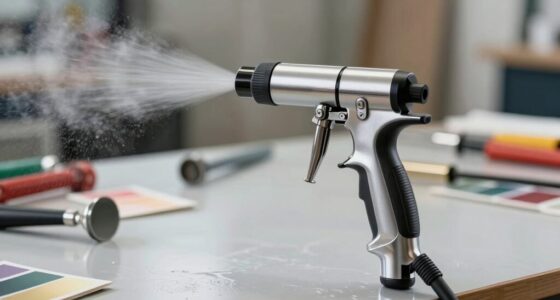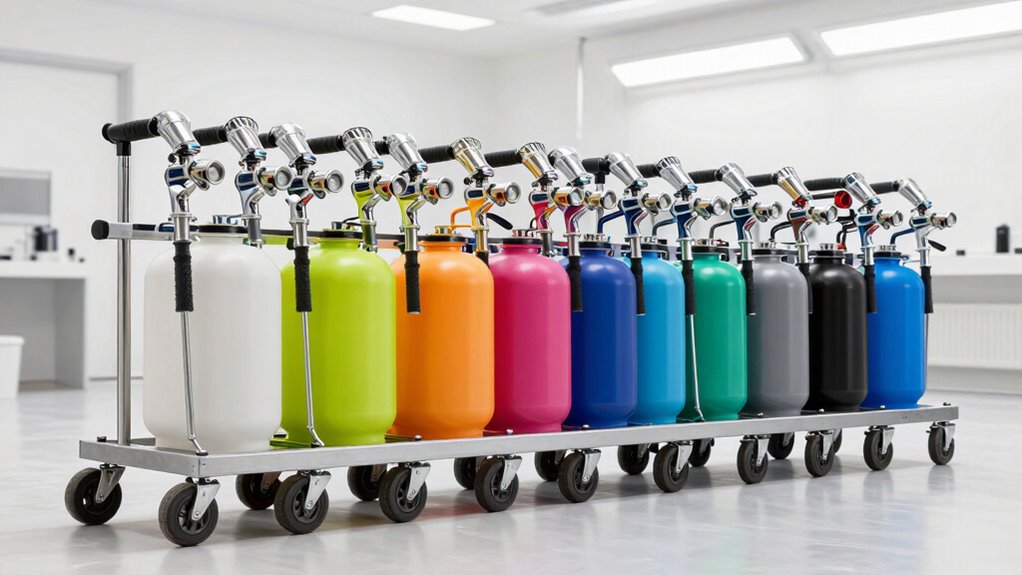

For most homeowners and serious DIY painters, I’d start with the Graco Magnum X7 Cart Airless Paint Sprayer for its established cart format and broad interior-to-exterior use. The Wagner Control Pro 190 is a standout for buyers who value reduced overspray, while the Graco ProX19 is a stronger fit for larger projects that call for a more capable setup. The main tradeoff is between established brand support and project-ready features versus lower-cost models that may offer high pressure and bundled accessories but less clarity about long-term support. Cart size, hose reach, cleanup, and the coatings you plan to spray matter as much as PSI. Read on for my full comparison and a guide to choosing a wheeled sprayer that fits your work.

Get business pricing on tools and workshop supplies
- Business-only prices and quantity discounts
- Tax-exempt purchasing
- Multiple users, one account, clear invoices
Complete the kit


Key Takeaways
- The Graco Magnum X7 is the clearest all-rounder: it pairs a familiar cart design with interior and exterior versatility, while the ProX19 and 210ES are better choices for buyers who need a more job-focused setup.
- Overspray control sets the Wagner and Titan apart: both Control Pro models use HEA positioning, making them worth a closer look when keeping mist down matters more than chasing the highest listed pressure.
- Several VEVOR and other value-oriented models cluster around 3000–3300 PSI: their listed pressure alone does not establish greater practical capacity; compare motor specifications, included hose and accessories, and support details.
- A cart helps most when the project covers ground: wheels and an extension rod can reduce carrying and ladder repositioning, but cart footprint and access through doors or around tight spaces still matter.
- Do not choose on accessory count alone: the named Graco and Wagner options have clearer product identities, while many budget listings need closer checking for service information, replacement parts, and coating guidance.


| cart airless paint sprayer with wheel | Maximum pressure | Hose length |
|---|---|---|
| Graco Magnum X7 Cart Airless P | — | — |
| VEVOR Stand Airless Paint Spra | 3000 PSI | — |
| VEVOR Stand Airless Paint Spra | 3000 PSI | — |
| VEVOR 750W Stand Airless Paint | 3000 PSI | — |
| Wagner SprayTech Control Pro 1 | — | 50 feet, extendable to 100 feet |
| BSMTEK Airless Paint Sprayer | 3300 psi | 9.5 m |
| VEVOR Stand Airless Paint Spra | 3300 psi | 50 ft |
| 1200W Cart Airless Paint Spray | 3300 PSI | 35 ft |
| InoKraft MaXpray M3 Cart Airle | 3300 PSI | — |
| VEVOR 750W Stand Airless Paint | 3000 PSI | — |
| Graco Magnum 261830 210ES Hi-B | — | 200 feet |
| POXURIO Airless Paint Sprayer | 3300 psi | 35 feet |
| Graco 17G180 Magnum ProX19 Car | — | — |
| Titan ControlMax 1900 Pro HEA | — | 50 feet, extendable to 100 feet |
More Details on Our Top Picks
Graco Magnum X7 Cart Airless Paint Sprayer, Interior & Exterior
The Graco Magnum X7 is my strongest all-around pick for buyers who want a wheeled cart sprayer with practical controls for both indoor and outdoor work. Its adjustable pressure lets painters tune the flow, while the stainless steel piston pump can spray unthinned paint. Unlike the VEVOR 650W model, which lists a higher maximum pressure and bundled accessories, the X7 puts particular emphasis on established job flexibility: it draws from 1- or 5-gallon buckets and supports up to 100 feet of hose for reaching multiple stories. The RAC IV tip can be reversed to clear a clog, though that does not eliminate clog-related pauses. Cleanup is also less convenient if a garden hose is not available, since the PowerFlush adapter depends on that connection.
Pros:- Adjustable pressure helps tailor paint flow to different surfaces and tasks.
- Stainless steel piston pump sprays unthinned paint.
- RAC IV SwitchTip reverses to clear clogs and reduce interruption time.
- Supports 1- and 5-gallon buckets and hose runs up to 100 feet.
Cons:- The reversible tip helps with clogs but does not prevent them.
- PowerFlush cleanup requires a garden hose connection.
Best for: Homeowners and frequent DIY painters who need a cart sprayer for mixed interior and exterior projects, with long-hose reach and adjustable paint flow.
Not ideal for: Painters without access to a garden hose for cleanup, or buyers who want every nozzle and accessory included rather than choosing components for their coatings.
- Power:110 volts
- Recommended annual use:125 gallons per year
- Maximum hose length:100 feet
- Bucket compatibility:1- or 5-gallon buckets
- Pump:Stainless steel piston pump
- Pressure control:Fully adjustable
- Clog-clearing tip:RAC IV SwitchTip
- Cleanup connection:PowerFlush adapter for garden hose
Our verdict“Choose the Graco Magnum X7 for a versatile cart sprayer with adjustable control and long-hose reach, provided garden-hose cleanup suits your setup.”
VEVOR Stand Airless Paint Sprayer, 650W, 3000 PSI High Pressure with Cart and Accessories
The VEVOR 650W cart sprayer suits buyers who want a ready-to-start package rather than a bare machine: the listed bundle includes a hose, extension rod, several nozzles, cleaning brush, and wheeled cart. Its 3000 PSI pressure and 0.31 GPM flow rate are aimed at covering fences, decks, and walls faster than hand application, while the adjustable pole helps reach higher or lower areas without shifting the machine as often. Compared with the Graco Magnum X7, this VEVOR supplies more listed accessories but does not specify a 100-foot hose capability or an annual-use recommendation. It draws from 1- to 5-gallon buckets, which may mean frequent bucket changes on large jobs. Careful nozzle setup matters too: overspray can waste paint if the spray pattern is poorly matched.
Pros:- Includes a cart, hose, extension rod, nozzles, and cleaning brush.
- The 3000 PSI maximum pressure and 0.31 GPM flow rate support quicker coverage of broad surfaces.
- Adjustable pole helps reach high and low areas while the cart stays nearby.
- All-metal frame and rubber hose are suited to regular jobsite handling.
Cons:- The listed bucket range tops out at 5 gallons, requiring refills on extended work.
- Incorrect nozzle or pressure setup can produce overspray.
- The provided specifications do not state maximum hose length or recommended annual use.
Best for: DIY painters tackling fences, decks, or rooms who want a wheeled machine with an extension rod and multiple nozzles in the package.
Not ideal for: Contractors handling very large continuous jobs who need documented long-hose reach or a stated high-volume annual-use rating.
- Motor power:650 W
- Flow rate:0.31 GPM
- Maximum pressure:3000 PSI
- Bucket compatibility:1- to 5-gallon buckets
- Frame:All-metal
- Included accessories:Cart, cleaning brush, hose, extension rod, and nozzles
- Pump maintenance:Detachable pump body
- Hose:Professional rubber hose
Our verdict“Pick this VEVOR when a bundled extension rod and nozzle set matter more than documented long-hose capacity.”
VEVOR Stand Airless Paint Sprayer with Cart, 950W, 3000 PSI
Among these VEVOR options, the 950W cart sprayer has the strongest stated flow, at 0.53 GPM, making it the better fit for painters prioritizing output on medium-to-large surfaces. Its 3000 PSI maximum pressure, adjustable speed control, and fan-shaped atomization are intended to support even coverage, while the wheeled cart avoids having to carry the machine between work areas. Compared with the 650W VEVOR, it lists substantially higher motor power and flow, but the added capacity comes with a 28.7-pound machine that is less convenient to lift into a vehicle or up stairs. The detachable pump makes cleaning more manageable, yet the product data still calls for careful maintenance to limit clogs. Its included components are less extensive than the 650W model’s listed nozzle bundle.
Pros:- Listed 0.53 GPM flow rate is higher than the 650W VEVOR’s 0.31 GPM.
- Adjustable speed control helps adapt output to the coating and task.
- Wheeled cart makes movement between nearby work areas easier.
- Full-metal frame, rubber hose, and detachable pump support jobsite use and cleaning.
Cons:- At 28.7 pounds, it is cumbersome to lift despite its wheels.
- Careful cleaning and maintenance are needed to reduce clog risk.
- The listed components do not include the multiple nozzles supplied with the 650W VEVOR.
Best for: Home renovators and property-maintenance crews covering medium-to-large areas who value higher listed flow and can roll the unit between work zones.
Not ideal for: Painters who frequently carry equipment upstairs, need a very compact sprayer, or want a complete set of included nozzles.
- Model:RP8628 plus
- Power:950 W
- Maximum pressure:3000 PSI
- Maximum flow rate:2.0 LPM
- Flow rate:0.53 GPM
- Item weight:28.7 pounds
- Dimensions:15.75 inches W × 37.4 inches H
- Materials:Full-metal frame and rubber hose
- Included components:Paint sprayer, cleaning brush, and extension pole
Our verdict“Choose this VEVOR for higher stated flow on larger jobs if you can manage its weight and handle routine pump maintenance.”
VEVOR 750W Stand Airless Paint Sprayer
The VEVOR 750W lands between the 650W and 950W VEVOR models on stated motor power, offering a 3000 PSI maximum and a listed maximum flow of 1.2 LPM. For buyers comparing cart sprayers, its useful distinction is adjustable speed control paired with a detachable pump body: output can be tuned for the task, and the pump can be removed for cleaning. Its full-metal frame and professional rubber hose also make it a more jobsite-oriented choice than a lightweight handheld unit. The tradeoff is that the product data does not give a GPM flow figure, bucket compatibility, hose length, or a cart-specific dimension, so direct capacity comparisons with the 950W VEVOR or the Graco Magnum X7 are limited. The included components list is also spare, with a cleaning brush but no listed extension pole.
Pros:- Adjustable speed control gives the operator a way to manage paint delivery.
- Detachable pump body supports more direct cleaning access.
- 3000 PSI maximum pressure is suited to broad-area spraying.
- Full-metal frame and professional rubber hose are built for repeated handling.
Cons:- The provided data lists maximum flow in LPM but does not give a GPM figure for easy comparison.
- Bucket compatibility and maximum hose length are not specified.
- Only a cleaning brush is listed among included components; an extension pole is not specified.
Best for: DIY painters who want a wheeled-style stand sprayer with adjustable speed and detachable-pump cleaning, without selecting the highest-powered VEVOR model.
Not ideal for: Buyers who need clearly specified flow, bucket range, hose reach, or a confirmed bundle with an extension pole and multiple nozzles.
- Brand:VEVOR
- Model number:RP8626
- Power:750 W
- Maximum pressure:3000 PSI
- Maximum flow rate:1.2 LPM
- Frame:Full-metal
- Hose:Professional rubber hose
- Included components:Paint sprayer and cleaning brush
- Pump:Detachable pump body
Our verdict“Consider the 750W VEVOR if adjustable output and detachable-pump cleaning matter more than detailed capacity specifications or a larger accessory bundle.”
Wagner SprayTech Control Pro 190 Cart HEA Paint & Stain Sprayer
The Wagner Control Pro 190 Cart stands apart from the VEVOR machines by prioritizing reduced overspray rather than the highest listed pressure. Its HEA system is described as cutting overspray by up to 55%, a practical advantage when paint drift and cleanup matter on exterior work or around finished spaces. The cart, 50-foot hose, and option to extend to 100 feet support movement across larger properties, while the variable-speed 0.70 hp pump handles paints and stains without thinning. Compared with the Graco Magnum X7, it offers a specific low-overspray claim, but its maximum operating pressure is lower at 1600 PSI and separate HEA tips are needed for different coatings. The larger cart can also feel like more equipment than a small DIY project warrants, and pressure and tip selection take practice.
Pros:- HEA system is described as reducing overspray by up to 55%.
- 50-foot hose can be extended to 100 feet for broad work areas.
- Variable-speed 0.70 hp pump handles unthinned paints and stains.
- Wheeled cart makes it easier to move the sprayer around a jobsite.
Cons:- Different coatings may require HEA tips purchased separately.
- Large cart format may be excessive for small, occasional projects.
- Selecting the right pressure and tip involves a learning curve.
Best for: Homeowners and property painters covering large interior or exterior areas who want to reduce overspray and need a cart with long-hose reach.
Not ideal for: Occasional painters handling small rooms, or buyers who want multiple coating-specific HEA tips included without purchasing them separately.
- Model number:0580559
- Maximum operating pressure:1600 PSI
- Pump horsepower:0.70 hp
- Flow rate:0.40 gallons per minute
- Hose length:50 feet, extendable to 100 feet
- Paint container compatibility:1- or 5-gallon containers
- Overspray reduction:Up to 55% as described
- Warranty:1-year limited
Our verdict“Choose the Wagner Control Pro 190 when limiting overspray and reaching across a large job matter more than a higher maximum-pressure rating.”
BSMTEK Airless Paint Sprayer – 1200W, 3300 PSI, Cart‑Mounted with Extension Rod and Wheels (Red)
The BSMTEK suits buyers who want a wheeled cart, strong motor and extra reach without stepping up to a bulkier, higher-capacity setup. Its 1200W motor and 0.47 gal/min flow rate match the output listed for the Dkenicor, while the 12-inch extension rod is shorter than that model’s 20-inch pole. The 9.5 m hose helps cover a work area without moving the cart as often, and adjustable pressure is intended to reduce paint waste. Compared with the InoKraft MaXpray M3, BSMTEK lists higher flow but does not include the M3’s reversible tip or stated cleaning features. Its main compromise is size: at just over 33 inches tall and about 20 inches wide, it may feel cumbersome in tight rooms or doorways.
Pros:- 1200W motor and 0.47 gal/min flow rate support fast coverage on sizable surfaces.
- 3300 psi maximum pressure with adjustable control gives users a way to tune application.
- 9.5 m hose helps extend reach while the cart stays in place.
- Wheels and a 12-inch extension rod support transport and overhead or low-area spraying.
Cons:- The cart’s 20.08-inch width may make tight indoor maneuvering difficult.
- The 12-inch extension rod offers less reach than the Dkenicor’s 20-inch pole.
- No included cleaning kit or reversible tip is specified, unlike the InoKraft MaXpray M3.
Best for: Homeowners handling larger indoor or outdoor painting jobs who want a powerful wheeled unit and hose reach for moving around the work area.
Not ideal for: People painting small rooms or working through narrow doorways, where the roughly 20-inch-wide cart can be awkward to maneuver.
- Motor power:1200 W
- Maximum pressure:3300 psi
- Flow rate:0.47 gal/min
- Motor speed:11,000 rpm
- Hose length:9.5 m
- Extension rod:12 in
- Dimensions:20.08 in W × 33 in H
- Power source:AC
Our verdict“Choose the BSMTEK for high-output cart mobility on larger jobs, but favor a narrower setup or a longer pole if tight access or extra reach matters more.”
VEVOR Stand Airless Paint Sprayer, 900W, 3300 PSI High Pressure Airless Sprayer with Cart, Cleaning Brush, Hose, Extension Rod, Nozzles – Electric Spray Paint Machine for Interior and Exterior
The VEVOR 900W is a practical fit for projects where the cart needs to stay put while the user works across a wide area. Its 50-foot hose is longer than the 35-foot line listed for the Dkenicor, reducing how often the sprayer needs repositioning. The 900W motor is less powerful on paper than the BSMTEK and Dkenicor’s 1200W motors, though VEVOR lists the same 0.47 GPM flow rate and 3300 psi maximum pressure. A five-gallon capacity, detachable pump body and included cleaning brush make it better equipped for larger paint sessions and cleanup than models without specified cleaning accessories. The tradeoff is its 30.4-pound weight and bucket limit: it is not a light carry, and very large jobs may call for refills.
Pros:- The 50-foot hose allows a wide working radius before the cart needs moving.
- Listed 0.47 GPM flow and 3300 psi pressure suit substantial coating jobs.
- Cleaning brush and detachable pump body provide useful maintenance support.
- Five-gallon capacity accommodates a standard large paint bucket.
Cons:- At 30.4 pounds, the unit can be cumbersome to transport and set up.
- The five-gallon capacity may require refills during especially large projects.
- Its 900W motor is lower-powered than the 1200W BSMTEK and Dkenicor.
Best for: DIYers painting broad interior or exterior areas who value a long hose, included cleaning tools and compatibility with a five-gallon paint bucket.
Not ideal for: Anyone who needs a lightweight sprayer to carry between floors or wants a tank larger than five gallons for uninterrupted large-scale work.
- Motor power:900 W
- Maximum pressure:3300 psi
- Flow rate:0.47 GPM
- Tank capacity:5 gallons
- Hose length:50 ft
- Item weight:30.4 lb
- Dimensions:15.35 in W × 35.04 in H
- Frame material:ABS shell with Q235 steel frame
Our verdict“Pick this VEVOR when hose reach and included cleanup tools matter more than low carry weight or a higher-rated motor.”
1200W Cart Airless Paint Sprayer with Extension Rod, 3300 PSI Thinning-Free for Home Exterior & Interior – Red
The Dkenicor’s clearest advantage is reach: its 20-inch extension pole and 35-foot hose give users room to spray high or low surfaces while the wheeled cart stays nearby. That pole is longer than the 12-inch extension listed for the BSMTEK, making this a stronger match for exterior walls, ceilings and other areas where stretching or moving a ladder is inconvenient. Its 1200W motor, 3300 PSI maximum pressure and 0.47 gallons-per-minute flow rate also put it in the same stated output class as BSMTEK. The five-liter tank is smaller than the VEVOR 900W’s five-gallon capacity, however, so buyers should expect more frequent paint replenishment. The product data also flags lifting the unit into a vehicle and post-job cleaning as practical burdens.
Pros:- The 20-inch extension pole provides more reach than the BSMTEK’s 12-inch rod.
- A 35-foot hose supports movement around a work area without constant cart repositioning.
- 1200W motor, 3300 PSI maximum pressure and 0.47 gallons-per-minute flow rate suit substantial projects.
- Industrial-grade rubber wheels support movement across varied surfaces.
Cons:- The five-liter tank is much smaller than the VEVOR 900W’s five-gallon capacity.
- The unit may be difficult for one person to lift into a vehicle.
- Cleaning is required after use to maintain performance.
Best for: Homeowners spraying walls, ceilings or exterior areas who want a longer extension pole and wheeled mobility for moving around the property.
Not ideal for: Crews covering very large surfaces in one session, or solo users who must frequently lift the sprayer into a vehicle and want less frequent refills.
- Motor power:1200 W
- Maximum pressure:3300 PSI
- Flow rate:0.47 gal/min
- Tank volume:5 L
- Extension pole length:20 in
- Hose length:35 ft
- Dimensions:16.54 in W × 33.07 in H
- Wheels:Industrial-grade rubber
Our verdict“Choose the Dkenicor when pole length and cart mobility are the priority, but look to a larger-capacity option for lengthy jobs with fewer refills.”
InoKraft MaXpray M3 Cart Airless Paint Sprayer, 3300 PSI 0.33 GPM
The InoKraft MaXpray M3 makes the most sense for buyers who value manageable maintenance and flexible hose routing over maximum listed flow. Its reversible 515 tip is designed to clear clogs without disassembly, while the Flush-Ease valve and cleaning kit give cleanup more attention than the product details provide for the BSMTEK or Dkenicor. Two included 25-foot hoses make 50 feet of reach, with the system described as extendable to 100 feet; that is more flexibility than the VEVOR 900W’s listed 50-foot hose. The tradeoff is its 0.33 GPM flow rate, below the 0.47 GPM figures listed for several other picks here. Its multi-hose arrangement and pressure adjustments may also take more setup know-how, so it is less appealing for a first-time user seeking a simple start.
Pros:- Reversible 515 tip provides a way to clear clogs without taking the sprayer apart.
- Two 25-foot hoses provide 50 feet of included hose and can be extended to 100 feet.
- 360-degree swivel cart helps reposition the sprayer around the work area.
- Flush-Ease valve and included cleaning kit support post-project maintenance.
Cons:- The 0.33 GPM maximum flow rate is lower than the 0.47 GPM listed for several alternatives.
- Multiple hoses and pressure adjustments can make setup less approachable for beginners.
- The cart-mounted design may be cumbersome for small jobs or frequent vehicle transport.
Best for: Experienced DIYers painting decks, fences or large walls who want a cart that swivels easily and value fast clog clearing and cleanup features.
Not ideal for: First-time sprayer buyers who want simpler setup, or users prioritizing the higher listed flow rates of the BSMTEK and VEVOR models.
- Maximum pressure:3300 PSI
- Maximum flow rate:0.33 GPM
- Included hose length:50 ft (two 25-ft hoses)
- Maximum stated hose reach:Up to 100 ft
- Extension length:18 in
- Tip type:Reversible 515
- Cart feature:360° swivel
- Warranty:1 year
Our verdict“Choose the MaXpray M3 if clog clearing, cleanup and flexible hose reach outweigh the higher flow rates and simpler setup of competing models.”
VEVOR 750W Stand Airless Paint Sprayer with Cart, 3000 PSI
This VEVOR is the more restrained choice for buyers who want cart mobility and adjustable application speed without matching the 3300 psi ratings of the BSMTEK, Dkenicor or VEVOR 900W. Its 750W motor and maximum 3000 PSI pressure are paired with an adjustable speed control, which can help users tailor application to the job rather than relying only on a higher-output setup. The full-metal frame and rubber hose give it a durable construction profile, while the detachable pump and included cleaning brush support upkeep. Compared with the VEVOR 900W, it lists lower power and pressure and does not specify a hose length, flow rate or tank capacity. That makes it harder to judge for extended work, and regular pump cleaning remains part of ownership.
Pros:- Adjustable speed control offers a way to tailor application to different tasks.
- Wheeled cart and extension pole support mobility and reach.
- Full-metal frame and wear-resistant components are suited to regular project use.
- Detachable pump and included cleaning brush support routine maintenance.
Cons:- Its 750W motor and 3000 PSI maximum pressure are below the 900W and 3300 psi ratings of the VEVOR 900W.
- The product data does not specify hose length, tank capacity or maximum flow rate.
- Regular cleaning of the detachable pump is needed to help prevent clogs.
Best for: DIY painters seeking a wheeled, metal-frame sprayer with adjustable speed for mixed interior and exterior tasks, without needing the highest stated pressure.
Not ideal for: People planning long, high-volume projects who need a documented flow rate, tank capacity or hose length to plan coverage and refills.
- Motor power:750 W
- Maximum pressure:3000 PSI
- Maximum flow rate:1.2 L/min
- Frame material:Full metal
- Hose material:Rubber
- Included components:Hose, nozzle, pump, cart, cleaning brush and extension pole
- Speed control:Adjustable
- Pump:Detachable
Our verdict“Pick this VEVOR for adjustable-speed control and a wheeled metal frame, but choose a higher-output model when documented capacity and faster coverage are priorities.”
Graco Magnum 261830 210ES Hi-Boy Cart Airless Paint Sprayer
The 200-foot hose is the main reason I’d choose this cart sprayer for large properties: it can reach far beyond the POXURIO’s 35-foot hose and may reduce how often I need to reposition the unit. Its 0.47-gallon-per-minute delivery rate and 3000 psi pressure are suited to covering broad surfaces with heavier coatings, while direct pickup from 1- or 5-gallon containers avoids repeated refills of a small reservoir. The tradeoff is limited control: the supplied 0.021-inch tip is the only size listed, and no adjustable pressure setting is specified. Compared with the Graco ProX19, this 210ES emphasizes hose reach and output rather than documented pressure adjustment and a reverse-tip feature. I’d favor it for expansive work, not detail-heavy jobs.
Pros:- 200-foot hose offers substantially more reach than the POXURIO’s 35-foot hose.
- 0.47 GPM delivery rate supports fast coverage across large surfaces.
- 3000 psi operating pressure is suited to demanding coating work.
- Draws paint directly from 1- or 5-gallon containers and can run on household current or a 1500 W generator.
Cons:- Only one listed 0.021-inch tip limits flexibility for finer work.
- No adjustable pressure setting is specified.
- Long hose and cart format may be more equipment than small jobs require.
Best for: Homeowners or contractors painting large exteriors who value long hose reach and fast coverage from a cart-mounted unit.
Not ideal for: Buyers who need fine-detail control, multiple tip options, or a clearly documented adjustable pressure setting.
- Delivery rate:0.47 gallons per minute
- Maximum operating pressure:3000 psi
- Tip size:0.021 inch
- Motor:1 HP
- Power requirement:15 A household current or 1500 W generator
- Hose length:200 feet
- Paint container compatibility:1- or 5-gallon containers
- Gun included:Yes
Our verdict“Choose the 210ES if long reach and high output matter more than adjustable pressure or fine-detail flexibility.”
POXURIO Airless Paint Sprayer, 1400W Electric High Efficiency with 3300PSI Pressure, Extension Rod, and Wheels
The POXURIO pairs a 20-inch extension rod with a wheeled cart, making it a practical choice for reaching elevated siding or fence sections without constantly moving a ladder. Its 35-foot hose is far shorter than the Graco 210ES’s 200-foot line, but that more compact reach can suit residential jobs where a very long hose would add handling and cleanup. The listed 3300 psi pressure and 1400 W motor are intended for thick coatings, including latex and epoxy, without thinning. That capability calls for careful technique: high pressure can make overspray harder to manage, and no adjustable-pressure feature is listed. Compared with the Titan ControlMax 1900 Pro, this model prioritizes stated pressure and an extension rod over HEA overspray reduction. I’d pick it for reach and coating versatility, while keeping expectations measured about long-term durability.
Pros:- 20-inch extension rod helps reach higher surfaces with less ladder repositioning.
- 35-foot hose provides useful reach for many residential painting tasks.
- 3300 psi maximum pressure and stated thinning-free support accommodate thick paints such as latex and epoxy.
- Wheeled cart makes moving the sprayer easier around a work area.
Cons:- 35-foot hose is much shorter than the Graco 210ES’s 200-foot hose.
- High pressure may require careful handling to limit overspray and mess.
- No adjustable-pressure feature is listed.
Best for: DIYers painting elevated fences, siding, or other home surfaces who want a wheeled sprayer, extension rod, and support for thicker coatings.
Not ideal for: Beginners especially concerned about overspray, or contractors who need a long hose and established service details for frequent heavy use.
- Model:KF370095-01AB
- Motor power:1400 W
- Maximum pressure:3300 psi
- Hose length:35 feet
- Extension rod length:20 inches
- Material:Metal
- Power source:AC
- Dimensions:10.8 inches wide x 17.91 inches high
Our verdict“Pick the POXURIO for elevated home projects where its extension rod and thick-coating support matter more than a very long hose or documented pressure adjustment.”
Graco 17G180 Magnum ProX19 Cart Paint Sprayer
I’d put the ProX19’s adjustable pressure and reverse-tip feature ahead of raw reach for buyers whose projects vary by coating or surface. Lowering or raising pressure gives more room to tune the spray, while reversing the RAC IV SwitchTip can clear a clog without stopping to dismantle the tip. The Graco 210ES offers a much longer listed hose—200 feet versus the ProX19’s maximum 150 feet—but its provided details do not mention adjustable pressure or reverse-tip recovery. The ProX19 also draws directly from 1- or 5-gallon buckets and includes an InstaClean pump filter. One practical limitation is cleanup: the included garden-hose adapter depends on access to a garden hose, which can reduce convenience at remote sites. Its listed annual-use guidance of up to 500 gallons makes this a stronger fit for recurring work than occasional touch-ups.
Pros:- Fully adjustable pressure helps match spray output to the task.
- Reverse-tip feature can clear clogs and reduce interruptions.
- Draws directly from 1- or 5-gallon paint buckets.
- Supports up to 150 feet of hose and includes an InstaClean pump filter.
Cons:- Cleanup adapter requires a garden-hose connection, limiting convenience at remote work sites.
- Maximum listed hose length is shorter than the Graco 210ES’s 200 feet.
- The provided specifications do not state a spray rate or maximum pressure.
Best for: Frequent DIY painters and handymen who need pressure adjustment, easier clog recovery, and bucket-fed spraying across varied projects.
Not ideal for: Buyers working far from a garden-hose connection or those whose highest priority is the longest possible hose reach.
- Model:17G180
- Voltage:110 volts
- Annual use recommendation:Up to 500 gallons per year
- Maximum hose length:150 feet
- Paint bucket compatibility:1- or 5-gallon buckets
- Pump type:ProX stainless steel piston pump
- Filter:InstaClean pump filter
- Clog-clearing feature:RAC IV reverse-tip SwitchTip
Our verdict“Choose the ProX19 if control and quicker clog recovery matter more to you than the 210ES’s longer hose reach.”
Titan ControlMax 1900 Pro HEA Airless Paint Sprayer with Low Overspray
The Titan’s strongest distinction is its HEA technology, which is specified to cut overspray by up to 55%. That makes it appealing for painters who want a more controlled application around landscaping, nearby surfaces, or occupied areas. Its 0.40 GPM spray rate is below the Graco 210ES’s 0.47 GPM, but the Titan pairs that output with a 50-foot hose extendable to 100 feet and a wheeled cart for moving around larger jobs. Its 1600 psi maximum is also lower than the 3000 psi listed for the Graco and 3300 psi for the POXURIO; the tradeoff is a setup centered on softer spray and reduced overspray rather than the highest pressure. The all-metal gun adds durability, though the unit may be cumbersome to transport and can be excessive for small projects.
Pros:- HEA technology is specified to reduce overspray by up to 55%.
- 50-foot hose can be extended to 100 feet for added job-site reach.
- Wheeled cart helps move the sprayer around larger projects.
- All-metal gun and 0.40 GPM spray rate support sustained painting work.
Cons:- 1600 psi maximum is lower than the Graco 210ES and POXURIO pressure ratings.
- Large, heavy unit may be awkward to transport even with its cart.
- Power and equipment may be excessive for small or infrequent projects.
Best for: DIYers and handymen painting broad surfaces who value a softer spray and less overspray around nearby areas.
Not ideal for: People handling occasional small touch-ups or buyers prioritizing maximum pressure and the highest listed delivery rate.
- Maximum operating pressure:1600 psi
- Pump horsepower:0.70 hp
- Spray rate:0.40 gallons per minute
- Annual capacity:500 gallons per year
- Hose length:50 feet, extendable to 100 feet
- Gun material:All-metal
- Overspray reduction:Up to 55%
- Portability:Cart with wheels
Our verdict“Choose the Titan if reduced overspray is your priority, and look to the Graco 210ES or POXURIO if higher listed pressure matters more.”

How We Picked
I compared these 14 models as wheeled, cart-style airless sprayers, not as a general list of paint tools. The ranking reflects how well each option appears suited to the job a cart sprayer should do: move around a room or exterior, support sustained spraying, reach work comfortably, and handle routine cleanup. I also weighed the usefulness of features such as extension rods, hose and nozzle inclusions, stated pressure and flow, and overspray-control design. Listed PSI is not a stand-in for real-world output, so I treated it as one specification rather than a verdict.
Ranking favors clear project fit and buyer confidence over the biggest numbers. Established product lines and purpose-specific features rank ahead of models whose listings provide less detail about service or replacement parts. Within the value group, the differences are often the motor rating, accessory bundle, and stated pressure; these specs do not by themselves prove durability or suitability for a particular coating. The result is a shortlist organized by use case, with meaningful tradeoffs called out rather than treating every cart and motor as interchangeable.
Factors to Consider When Choosing Cart Airless Paint Sprayer With Wheels
Before choosing a cart airless sprayer, I’d match the machine to the work pattern, not just the pressure printed in its name. These broader checks can prevent a mismatch that product feature lists rarely make obvious.
Match Output to Coating and Project Size
Start with the coatings you expect to spray and check the manufacturer’s guidance for the sprayer, tip, and material. A high PSI figure does not tell you how quickly a machine can deliver paint, how well it sustains that output, or which tip it supports. For fences, broad siding, or several rooms, a suitable flow rate and manageable refill routine may matter more than a slightly higher pressure number. For occasional furniture or small rooms, a large-capacity setup can add cleanup and storage work without saving much time. Do not assume that “thinning-free” applies to every paint; follow the coating and machine instructions. When two models list similar pressure, use their stated flow, supported tips, and clear coating guidance to make the comparison.
Check Cart Fit, Weight, and Route to the Work
Wheels make a sprayer easier to move across a worksite, but they do not make every machine easy to transport. Think through doorways, stairs, thresholds, gravel, and the route between the paint supply and the spray area. A cart that rolls well over a garage floor may be awkward in a finished home or on uneven ground. Check the product dimensions and whether the sprayer can be lifted or separated from its base if you must carry it. Also plan where the hose will run: a long hose can limit how often the cart needs to move, but it adds storage and handling. Buyers who mainly work in tight rooms may be better served by a smaller setup, even if a larger cart appears more capable on paper.
Treat Overspray as a Site-Preparation Issue
Reduced-overspray technology can help, but it does not remove the need to mask and cover nearby surfaces. Wind, spray distance, tip choice, paint viscosity, and operator technique can all affect where paint lands. On occupied homes or near cars, plants, windows, and neighboring property, protecting the surroundings can take more time than the spraying itself. HEA models such as the Wagner and Titan options are worth comparing when mist control is a priority, but their labels should not be read as a promise of zero overspray. Ask whether the project has enough space to manage spray safely and whether a brush or roller would be simpler for small, detailed areas. Planning containment first can prevent a fast sprayer from creating a slow cleanup job.
Account for Cleaning Time and Replacement Parts
Airless equipment needs prompt, thorough cleaning after use, and the process depends on the coating and the maker’s instructions. Before buying, look for clear guidance on flushing, filters, tips, and storage, along with access to replacement parts. An included cleaning brush or extra nozzle can be useful, but it does not tell you how easy it will be to find a compatible replacement later. For occasional projects, a machine that is easier to maintain may be a better fit than one with a longer accessory list. If you switch between paint types or colors, factor in the time and material needed to flush the system each time. Buyers who expect frequent use should give support and parts availability more weight than a small difference in listed PSI.
Decide Whether an Extension Rod Solves Your Reach Problem
An extension rod can help with ceilings, tall walls, and exterior siding by reducing ladder movement and awkward overhead spraying. It also adds reach and leverage, which may make precise control harder until you are familiar with the setup. Match the rod length to the surfaces you actually need to coat rather than assuming longer is always better. For detail work, corners, and narrow trim, a standard gun may offer more control. Check whether a rod is included, compatible with the gun, and suitable for the intended tip. A useful extension can improve safety and pace, but it cannot replace stable footing, masking, or careful spray technique.
Choose Brand Support or Bundle Value Deliberately
Budget-focused listings often highlight motor wattage, pressure, and included accessories, while established lines may offer a clearer trail for instructions, compatible parts, and service. Neither approach automatically guarantees better results; the right choice depends on how much uncertainty you are willing to manage. For a one-off project, a bundled setup may be attractive if it includes the accessories you need and its coating guidance is clear. For repeated work, the ability to identify and replace wear parts can matter more over time than extra nozzles in the box. Compare the exact model and its documentation, not just the brand name or a shared product-family label. If you cannot confirm tip compatibility, maintenance steps, or replacement-part details, treat that as a meaningful buying risk.
Frequently Asked Questions
Is a cart airless paint sprayer with wheels worth it for one room?
It can be, especially if the room has broad walls or you also plan to paint ceilings and nearby spaces. For a small room with lots of trim, doors, or furniture, masking and flushing may take longer than applying paint with a roller. A cart is most useful when you can roll the unit along a clear route and keep the hose from snagging. Consider the full setup and cleanup effort, not only the speed of spraying. If this is a one-time, limited-area project, renting or using a roller may be the simpler choice.
Should I choose a 3300 PSI model over a 3000 PSI model?
Not on pressure alone. The difference in the listed figures does not tell you how much paint the sprayer can deliver over time, which tips it supports, or how it handles your chosen coating. Compare flow-rate information, motor specifications, tip compatibility, and the maker’s coating guidance. The 3000 PSI VEVOR listings and higher-pressure options in this roundup show why it helps to read the complete specification rather than rank machines by one number. Choose the model whose documented capabilities match the material and scale of your project.
Do HEA sprayers mean I can skip masking?
No. HEA design can be appealing when reducing overspray is a priority, but it does not eliminate airborne paint or the risk of stray spray. Mask glass, floors, fixtures, vehicles, and nearby plants, and check wind conditions before exterior work. Spray distance, tip condition, pressure settings, and technique also affect the result. The Wagner Control Pro 190 and Titan ControlMax 1900 Pro are relevant options to compare for this need, but both still call for proper preparation. Plan for containment as part of the job, not as an optional extra.
Can I use an extension rod instead of a ladder?
An extension rod can reduce ladder repositioning for some walls and ceilings, but it does not make every elevated task safe from the ground. The correct reach depends on your height, the rod, the gun, and the surface; added length can also make the gun harder to control. For high or awkward areas, follow the equipment instructions and use stable, appropriate access equipment when needed. Confirm that the rod fits the sprayer and is suitable for the selected tip. Treat it as a reach aid, not a substitute for safe work positioning.
What should I check before choosing a lesser-known cart sprayer?
Check whether the manufacturer provides clear instructions, cleaning steps, supported tips, and guidance for the paints you intend to use. Look for compatible replacement filters, hoses, guns, and seals, since these parts can affect how practical the sprayer is after its first project. Confirm that the listed cart, extension rod, and accessories are included with the exact model rather than assumed from a product photo or a related listing. Compare the stated motor, pressure, and flow information with established alternatives, while treating headline specs as claims rather than proof of durability. If service and parts details are hard to verify, favor a model with clearer support for repeated use.
Conclusion
My best overall pick is the Graco Magnum X7 for buyers who want a versatile cart sprayer for a mix of interior and exterior work. For best value, compare the VEVOR cart models by their exact motor rating, included equipment, and documentation instead of choosing by PSI alone; the 650W option is the most modestly specified cart entry here. For a best premium direction, the Graco ProX19 suits buyers prioritizing a more job-focused established line, while the Titan ControlMax 1900 Pro is the better fit when reduced overspray is a leading concern. Beginners may prefer the Wagner Control Pro 190 if its overspray-focused approach matches the project, but should still plan for masking and practice. For large or elevated surfaces, focus on hose reach, compatible extension rods, and a cart that suits the site; the Graco 210ES and models bundled with extension rods merit comparison. The right choice is the one whose support, reach, and coating guidance fit your project—not simply the machine with the largest number in its title.
Halloween Picks
halloween
As an affiliate, we earn on qualifying purchases.